About Acianthus fornicatus R.Br.
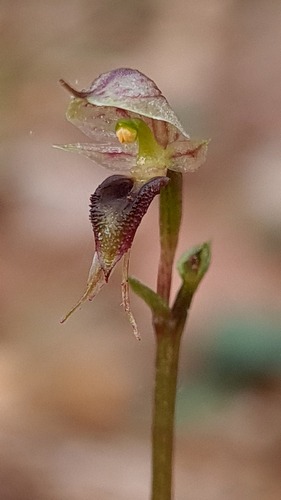
Acianthus fornicatus R.Br. is a terrestrial, perennial, deciduous, sympodial herb. It grows a single heart-shaped, glabrous, dark green leaf that is reddish-purple on its lower surface. The leaf itself is 10–40 mm (0.4–2 in) long and 10–20 mm (0.4–0.8 in) wide, and is borne on a stalk 4–9 cm (2–4 in) high. Up to ten well-spaced flowers are arranged on a raceme 100–300 mm (4–10 in) tall. Each individual flower is 10–40 mm (0.4–2 in) long, translucent, and pinkish-red, with a green, sometimes blackish labellum. The dorsal sepal is broadly egg-shaped, 9–12 mm (0.4–0.5 in) long and 5–6 mm (0.20–0.24 in) wide, and forms a hood over the flower's column. The lateral sepals are 9–12 mm (0.4–0.5 in) long and approximately 1.4 mm (0.06 in) wide, with 2–4 mm (0.08–0.2 in) long tips; they may be crossed or parallel to one another. The petals are about 4 mm × 1 mm (0.2 in × 0.04 in) in size and spread widely. The labellum is green, rarely blackish, and shaped from egg-shaped to lance-shaped, with its outer edges folded under. When flattened, the labellum is heart-shaped, 5–6 mm (0.20–0.24 in) long and 2.5–3 mm (0.098–0.12 in) wide. A thick, fleshy callus covers most of the central area of the labellum, and there are many small pimple-like papillae on its outer half. Flowering occurs between May and August. This species can be distinguished from other members of the genus Acianthus by its moderately large, projecting flowers, usually pinkish colouring, and its broad dorsal sepal and labellum. This species, commonly called the mosquito orchid, is widespread and common in coastal and near-coastal areas. It grows in heathy forest and coastal scrub, in well-drained sandy loam. It is found in Queensland and in New South Wales, ranging as far south as Eden.