About Acheta domesticus (Linnaeus, 1758)
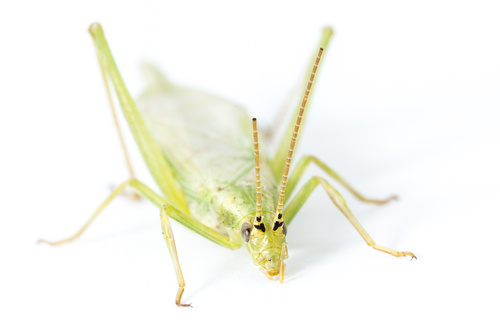
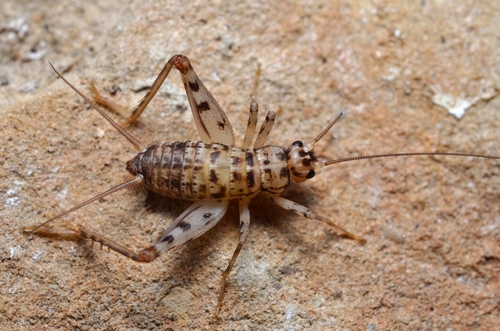
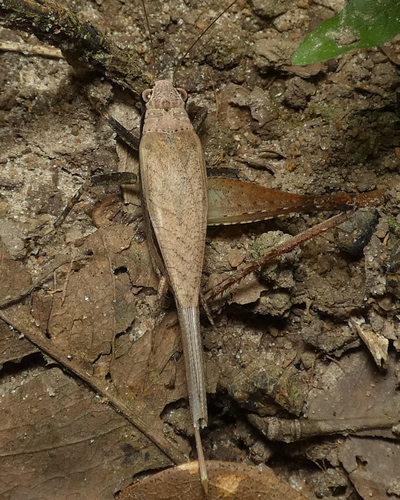
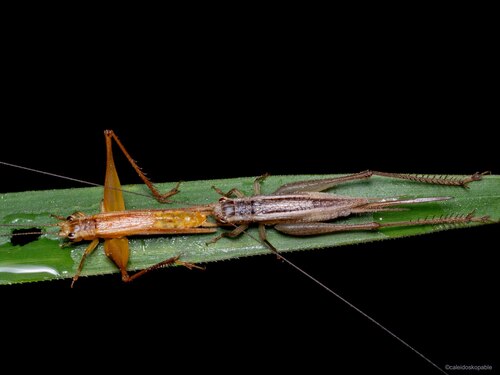
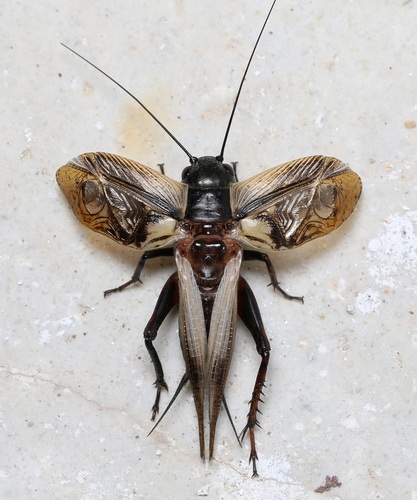
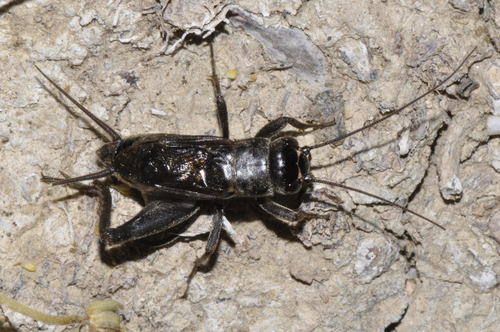
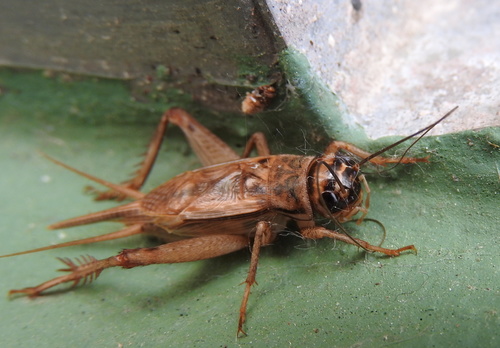
The house cricket, Acheta domesticus, is typically gray or brownish in color, and grows to 16–21 millimetres (0.63–0.83 in) in length. Males and females look similar, but females have a brown-black, needle-like ovipositor that extends from the center of their rear end. This ovipositor is approximately the same length as the cerci, the paired appendages located on the rearmost segment of the cricket. In males, the cerci are more prominent. House crickets take two to three months to complete their full life cycle when kept at temperatures between 26 to 32 °C (79 to 90 °F). They do not have a specialized overwintering life stage, but can survive cold weather inside and around buildings, as well as in dumps where heat from fermentation can sustain them through cold periods. Females deposit their eggs in any available moist substrate. Juvenile house crickets resemble adult individuals, except they are smaller and do not have wings. The house cricket is an edible insect. It is farmed for human consumption in South-East Asia and parts of Europe and North America. In Asia, it has become more popular than many native cricket species, because consumers report that it has a superior taste and texture. Dry-roasting is a common preparation method, and is considered the most nutritious way to prepare house crickets, though they are also often sold deep-fried. Most farmed house crickets are freeze-dried, and frequently processed into a powder known as cricket flour. In Europe, the house cricket has official approval for use in food products in Switzerland, where approval was granted in 2017, and in all European Union member states, where approval was granted in 2022. In the EU, the house cricket was approved as a novel food in frozen, dried and powdered forms through Commission Implementing Regulation (EU) 2022/188, issued on 10 February 2022. Before this approval, the European Food Safety Authority published a safety assessment on 17 August 2021, which stated that frozen and dried formulations made from whole house crickets are safe for human consumption. Despite these regulatory approvals, large-scale industrial production of house crickets still faces significant challenges. In North America, Aspire Food Group opened the world’s largest cricket processing facility in London, Ontario, in 2022, with an annual production capacity of 13 million kilograms. However, despite receiving government support, the company encountered financial difficulties and was forced to sell its assets in 2025 due to high debt. This case illustrates some of the economic and logistical challenges that come with scaling insect farming for human consumption.