About Acherontia atropos Linnaeus, 1758
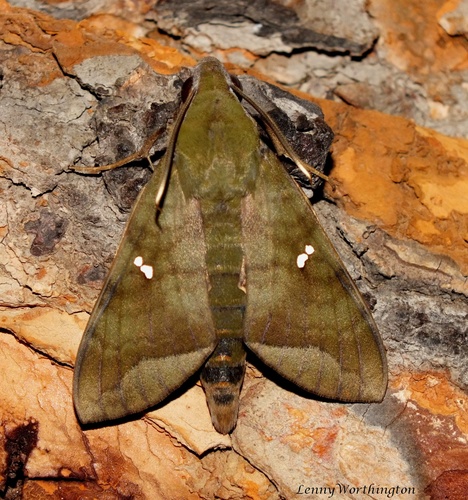
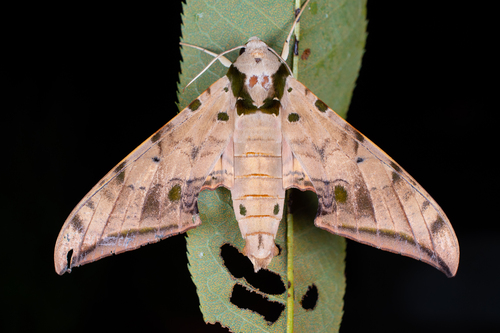
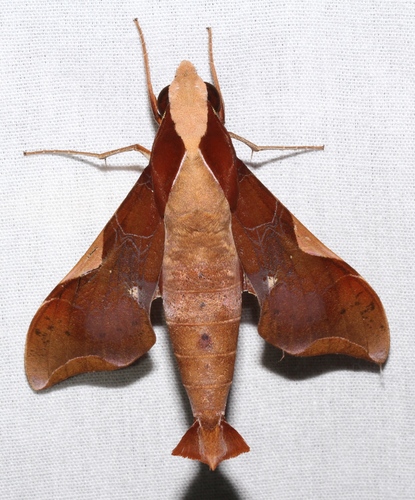
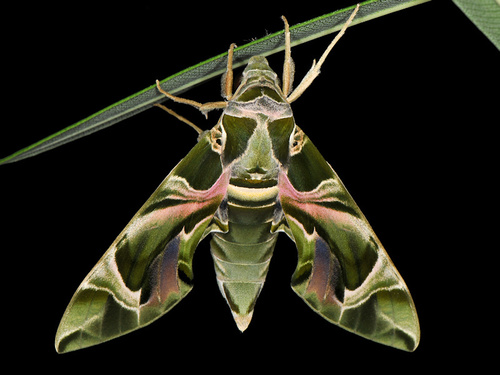
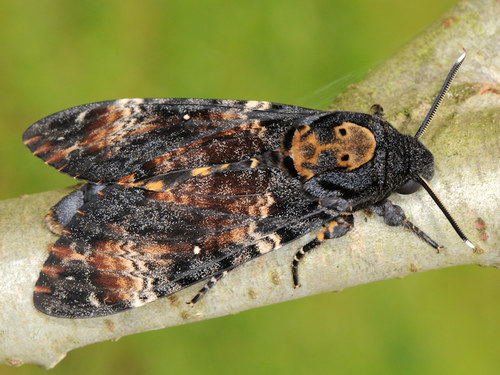
The African death's-head hawkmoth, Acherontia atropos, is a large hawk moth, and the largest moth found in the British Isles and several other regions it inhabits. Its wingspan measures 80–120 mm, or 5 inches (13 cm). It is a powerful flier, and individuals have sometimes been found on ships far from land. Its forewings are mottled dark and pale brown; other descriptions note the upper wings are brown with hints of yellow, amber, charcoal, and cream. Its hind wings are orangey-buff with two narrow dark bands parallel to the hind margin; other descriptions note lower wings are yellow with two wavy brown diagonal stripes across their surface. The abdomen is a similar orangey-brown, with a broad dark dorsal stripe; it is also robust, covered in brown feathery down, with yellow striping across each abdominal segment that closely resembles the color pattern of a hornet. The moth's most notable feature is a patch of short yellowish hairs on the thorax shaped to look like a human skull. This is a striking insect, but it is seldom seen because it flies late at night. Its wing and body structure is typical for the family Sphingidae. When at rest, the moth folds its wings downward, hiding the hindwings behind the forewings. A 2020 study describes that when viewed upside-down, Acherontia atropos creates the illusion of a head with eyes: the thorax's skull-shaped mark acts as a "nose", with the skull's eye-sockets appearing as nostrils, while spots on the forewings look like eyes, and other markings form what can be interpreted as ears, a muzzle, and lips. This illusion is also seen in Agrius convolvuli (the convolvulus hawk-moth) and five other species. The study author suggests the function of this eyed head illusion is almost certainly to deter, distract, or otherwise deceive predators. Like most Lepidoptera, this species shows sexual dimorphism. Females tend to be larger than males, appearing bulkier with larger, more robust abdomens. The male abdomen is less broad, with a pointed distal (lower) abdominal segment, while the female's distal abdominal segment is rounded at the tip. Males also have thinner, shorter antennae than females. The caterpillar of the African death's-head hawkmoth is sturdy and somewhat variable in color, occurring in shades of buff, green, or brown, with seven diagonal blue lines. It has a curved, thorn-like horn at its rear, and can reach a length of 5 to 6 inches (13 to 15 cm). The other two death's-head hawkmoth species also have three larval color forms, typically green, brown, and yellow. The pupa is stout and reddish-brown, formed 8 to 10 inches (20 to 25 cm) underground in a chamber about the size of a large hen's egg. Acherontia atropos occurs throughout the Middle East and Mediterranean region, across most of Africa all the way to its southern tip, and increasingly occurs as far north as southern Great Britain, due to recent mild British winters. Its range extends east to India and western Saudi Arabia, and west to the Canary Islands and Azores. It frequently invades western Eurasia, though few individuals successfully overwinter there. Sometimes a new generation appears even above the Arctic Circle; for example, an individual was recorded in northern Sweden (68°12’21.3”N 21°50’18.1”E) on 6 September 2019, after an exceptionally warm summer.