About Achaea janata (Linnaeus, 1758)
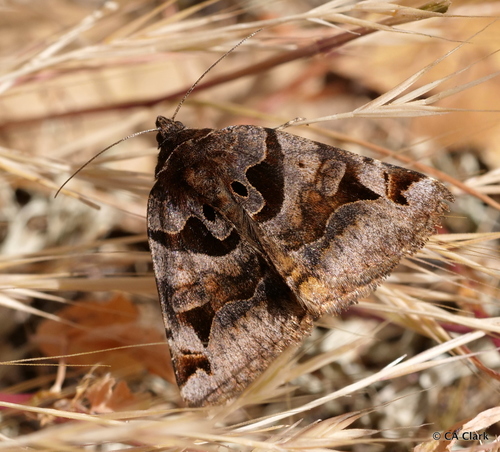
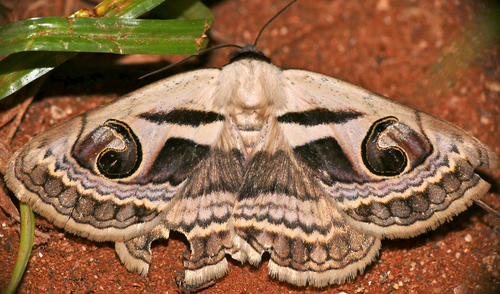
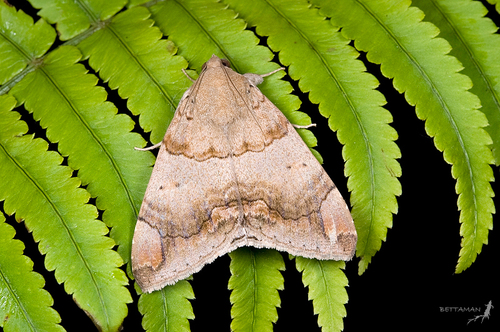
Achaea janata has a wingspan of approximately 60 to 70 mm, and a pale reddish-brown body. Its forewings bear prominent markings, including a short sub-basal waved line, an obliquely waved antemedial line, and an excised postmedial line; postmedial lines are often suffused with black on the inside. A single speck is located at the end of the cell, and a diffuse rufous band runs beyond the postmedial line. The hindwings are black with a medial white band. Three large white spots appear on the outer margin, along with whitish cilia. The ventral side is suffused with grey. Forewings have an oblique white postmedial band that does not reach the costa, and each wing bears two crenulate medial lines. Eggs are small, spherical, and greenish. Pupae are whitish green. Larvae are bluish grey and speckled with blue-black. The larval head is marked with black stripes. Lateral and sub-lateral yellowish bands are present, with a blue-grey line between them. A dorsal black stripe, bordered by reddish-white spots, occurs between the fourth and fifth somites. A pair of dorsal red tubercles is found on the anal somite. Spiracles and forelegs are red. Larvae go through four instars before entering the pupal stage. Known host plants of Achaea janata larvae include Excoecaria cochinchinensis (Euphorbiaceae), castor oil plant (Ricinus communis), all Brassica and Ficus species, plus a range of other crops and plants: Arachis hypogaea, Citrus, Corchorus, Dalbergia sissoo, Dodonaea viscosa, Euphorbia hirta, Glycine max, Lagenaria siceraria, Punica granatum, Rosa chinensis, Solanum lycopersicum, Tamarindus indica, Theobroma cacao, Vigna mungo, and Ziziphus mauritiana.