About Acer spicatum Lam.
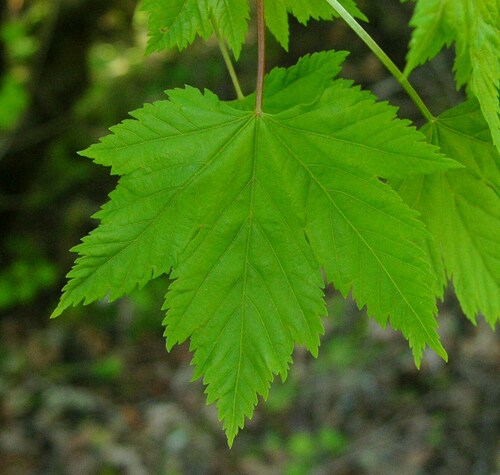
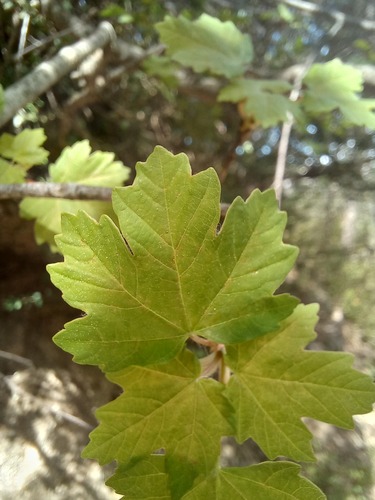
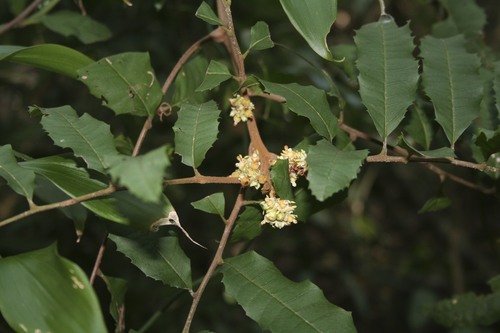
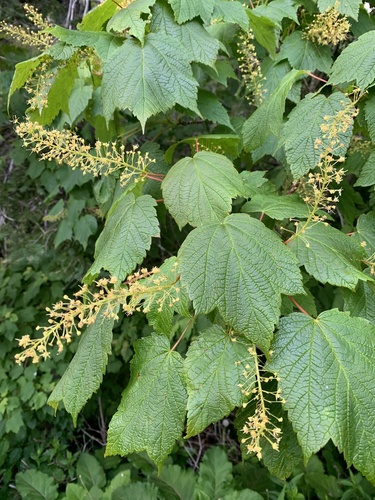
Acer spicatum Lam. is a deciduous shrub or small tree that reaches 3–8 m (10–25 ft) in height. It grows a short trunk, slender branches, and forms a spreading crown. Its leaves are opposite and simple, measuring 6–10 cm (2+1⁄4–4 in) in both length and width, and have 3 or 5 shallow broad lobes. The leaf margins are coarsely and irregularly toothed; the upper surface is light green and hairless, while the underside is finely hairy. In autumn, the leaves turn a brilliant yellow to red. Leaves grow on slender stalks that are usually longer than the leaf blade. The bark is thin, dull gray-brown, and smooth when young, becoming slightly scaly with age. The species produces paired reddish samara fruits, 2–3 cm (3⁄4–1+1⁄4 in) long, that mature from late summer to early autumn. In terms of distribution and ecology, Acer spicatum grows in moist woods with rich, well-drained soil, found on rocky hillsides and along streams. It also grows on ravines, cliff faces, and forested bogs, and colonizes the understory of hardwood forests. Mammals including moose, deer, beavers, and rabbits browse its bark, while ruffed grouse eat its buds. For uses, the sap of Acer spicatum is a source of sugar that can be boiled to make maple syrup. Its bark contains tannins used in leather tanning. Indigenous peoples infuse the pith of young twigs to create treatments for eye irritation, and make poultices from boiled root chips. It is also reported to be used to relieve stress in humans. Its wood is a popular choice for making musical instruments due to its high strength and durability.