About Acer sempervirens L.
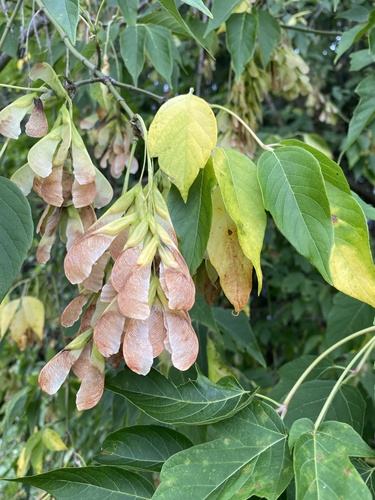
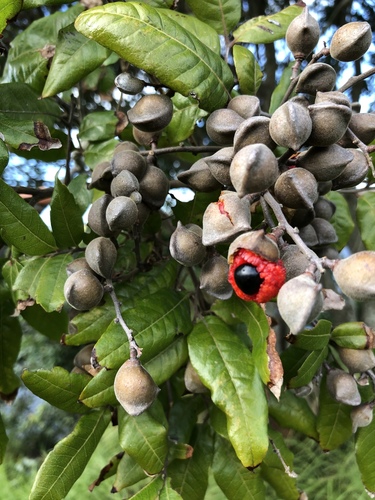
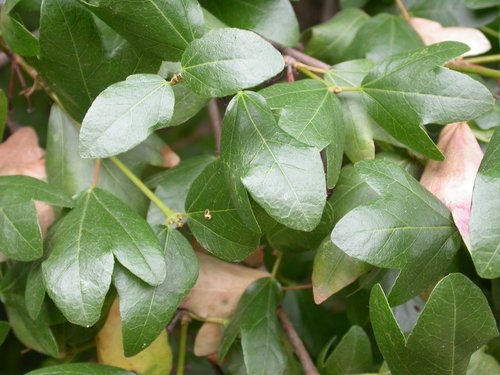
Acer sempervirens L., commonly known as Cretan maple, is an evergreen or semi-evergreen shrub or small tree, and it is one of the very few evergreen species in the Acer genus. This plant reaches up to 10 metres (33 ft) in height, with a trunk that can grow up to 50 centimetres (20 in) in diameter. Young trees have smooth, dark grey bark; this bark becomes scaly and shallowly fissured as the tree matures. New shoots are green when first produced, turning dull brown by their second year. The leaves are arranged oppositely, with a hard, leathery texture. They measure 1–4 centimetres (0.39–1.57 in) long and 1–3 centimetres (0.39–1.18 in) across, and are glossy dark green, attached to a 1 centimetre (0.39 in) yellow petiole. Leaves are variable, being either unlobed or three-lobed, often with both forms occurring on the same shoot, and all lobe margins are entire (toothless). The yellow-green flowers are borne in small pendulous corymbs. The fruit is a double samara that holds two rounded, winged seeds; the wings are 1.5–3 centimetres (0.59–1.18 in) long and spread at an acute angle. This is one of the most drought- and heat-tolerant species in the Acer genus, and it naturally grows on dry, sunny hillsides at moderate elevations. It is closely related to Acer monspessulanum, which occurs further north and west in Europe; it differs from that species in being smaller, often growing as a shrub rather than a large tree, and having smaller evergreen leaves. This species has a limited native range: it occurs only in Greece (specifically the Peloponnese, the Aegean Islands, and Crete) and southwestern Anatolia, Turkey. It grows best in mountainous areas at elevations between 300 and 1,700 meters. It is most commonly found in maquis, forest edges, and roadside thickets, and occasionally forms pure stands on Greek islands. In Greece, it is especially common on limestone slopes that host scattered Juniperus drupacea trees. On Crete, it grows alongside the endemic Zelkova abelicea, and is often classified as a pioneer or secondary forest species. Cretan maple is occasionally cultivated as an ornamental tree in western Europe. It was first introduced to Britain in 1752. In 1702, Joseph Pitton de Tournefort planted a Cretan Maple in Paris's Jardin des Plantes, and this individual tree still remains standing today.