About Acer saccharum Marshall
Acer saccharum Marshall, commonly known as sugar maple, is a deciduous tree that normally grows 25–35 m (80–115 ft) tall, with exceptional individuals reaching up to 45 m (150 ft). A 10-year-old sugar maple is typically around 5 m (20 ft) tall. Like most trees, sugar maples grown in forests develop much taller trunks and narrower canopies than those grown in open areas.
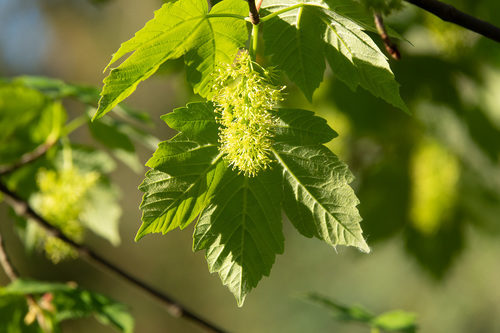
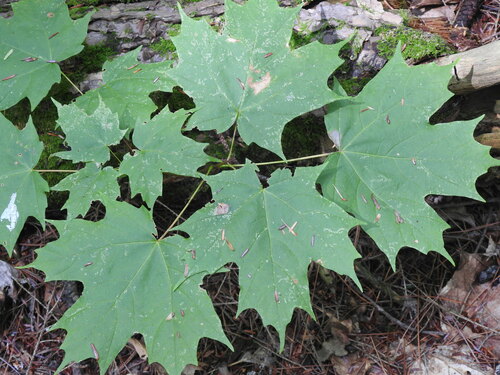
Its leaves are deciduous, growing up to 20 cm (7.9 in) long and wide. They are palmate with five lobes, borne in opposite pairs: the basal lobes are relatively small, while the upper lobes are larger and deeply notched. Unlike the angular notches of silver maple leaves, the inner edges of sugar maple notches are typically rounded. Sugar maple fall foliage is often spectacular, ranging from bright yellow through orange to fluorescent red-orange across different trees. This species also tends to develop uneven fall color: some individual trees display all of these color shades at the same time. Along with red maples, sugar maples often have sections of a mature tree that change color weeks earlier or later than the rest of the tree. Sugar maple leaf buds are pointed and brown; new twigs from the most recent year of growth are green, and darken to brown as they age.
Sugar maple flowers grow in panicles of 5 to 10 flowers each. The flowers are yellow-green and petal-less, blooming in early spring after 30–55 growing degree days. Trees generally start flowering when they are between 10 and 200 years old. The fruit is a pair of winged seeds called samaras. The globose seeds measure 7–10 mm (9⁄32–13⁄32 in) in diameter, and their wings are 2–3 cm (3⁄4–1+1⁄4 in) long. Seeds fall from the tree in autumn, and require 45 days of exposure to temperatures below 4 °C (39 °F) to break down their seed coating. Germination is slow, and does not occur until the following spring, once soil has warmed and all risk of frost has passed.
Acer saccharum is closely related to black maple, which some botanists include within this species, while others separate it as a distinct species Acer nigrum. Some botanists also treat western sugar maple (Acer grandidentatum) and southern sugar maple (Acer floridanum) as varieties or subspecies of the northern sugar maple. Sugar maple is often confused with Norway maple, a non-native species commonly planted in North American cities and suburbs that is not closely related to sugar maple within the Acer genus. Sugar maple can be easily distinguished by clear sap in its leaf petiole (Norway maple has white sap), brown sharp-tipped buds (Norway maple has blunt, green or reddish-purple buds), and shaggy bark on older trees (Norway maple bark has small grooves). Sugar maple leaf lobes also have a more triangular shape, compared to the squarish lobes of Norway maple.
Sugar maple is an extremely important species for the ecology of many forests in the northern United States and Canada. Pure sugar maple stands are common, and it is a major component of northern and Midwestern U.S. hardwood forests. Since it requires cold winters, sugar maple is mostly found north of the 42nd parallel in USDA growing zones 3–5. It is less common in the southern part of its range (USDA Zone 6) where summers are hot and humid, and in this region it is confined to ravines and moist flatlands. In the eastern portion of its range, south of Maryland, sugar maple is only found in the Appalachians. In the west, Tennessee marks the southern limit of its range, and Missouri marks its southwestern limit. Sap collection for sugar production is not possible in the southern part of sugar maple's range, as winter temperatures do not get cold enough.
The minimum seed-bearing age of sugar maple is around 30 years. It is a long-lived tree, typically reaching 200 years of age, and occasionally living as long as 300 years. Sugar maple is native to cooler climate areas and requires a hard freeze each winter for proper dormancy. In the northern part of its range, average January temperatures are around −18 °C (0 °F) and average July temperatures are around 16 °C (61 °F); in the southern part of its range, average January temperatures are around 10 °C (50 °F) and average July temperatures are almost 27 °C (81 °F). Sugar maple seed germination requires extremely low temperatures, with optimal conditions just slightly above freezing — no other known tree species has this trait. Germination rarely occurs at temperatures above 10 °C (50 °F).
Acer saccharum is among the most shade-tolerant large deciduous trees; very old trees in second-growth areas can grow to a large size even after spending many years in the understory. Only the smaller striped maple has greater shade tolerance than sugar maple. Like other maples, its shade tolerance is seen in its ability to germinate and persist under a closed canopy as an understory plant, then grow rapidly when a canopy gap creates increased light. Sugar maple can tolerate nearly any soil type except pure sand, but cannot tolerate dry (xeric) or swampy conditions. It has deeper roots than most maples, and engages in hydraulic lift: it draws water from lower soil layers and releases it into upper, drier soil layers. This benefits both the sugar maple itself and many other plants growing around it. The mushroom Pholiota squarrosoides is known to decay sugar maple logs.
Human activity has contributed to the decline of sugar maple in many regions. Since it is a species of mature forests, it is often replaced by more opportunistic species in areas where forests are logged. Sugar maple is also more susceptible to pollution than other maple species. Acid rain and soil acidification are among the main factors driving maple decline. Increased use of deicing salt on streets and roads over recent decades has also eliminated sugar maple as a common street tree. In parts of New England, especially near urbanized areas, sugar maple is being displaced by Norway maple. Norway maple is also highly shade tolerant, but much more tolerant of urban conditions, leading to it replacing sugar maple in these areas. Norway maple also produces much larger seed crops, allowing it to out-compete native species like sugar maple.
Along with black maple, sugar maple is the main source of sap for making maple syrup, making it one of the most important tree species in Canada. Other maple species can be used to produce maple syrup, but they generally have lower sugar content and/or produce cloudier syrup than sugar maple and black maple. To produce maple syrup from Acer saccharum, sap is extracted by tapping a hole drilled through the phloem, just inside the bark. Collected sap is then boiled to evaporate water, leaving concentrated syrup; 40 gallons of sap produces one gallon of syrup. Sugar maples in the southern part of the range produce little sap, so commercial syrup production depends on trees grown in cooler climates.
Sugar maple samaras (seeds) can be made edible by soaking, removing their wings, then boiling, seasoning, and roasting. The young leaves and inner bark can be eaten either raw or cooked. The Mohegan people use the inner bark as a cough remedy, and the sap as a sweetening agent; they have made maple syrup from it after the introduction of European metal cookware.