About Acer saccharinum L.
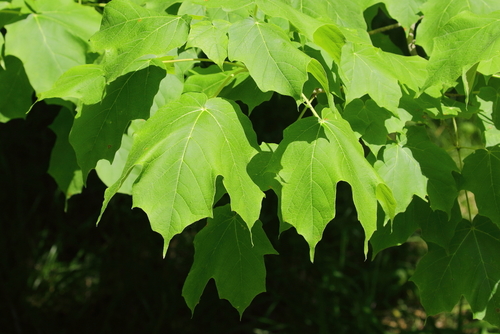
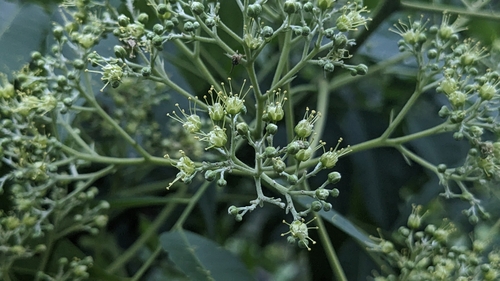
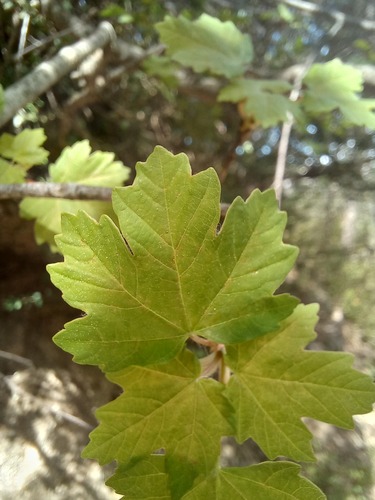
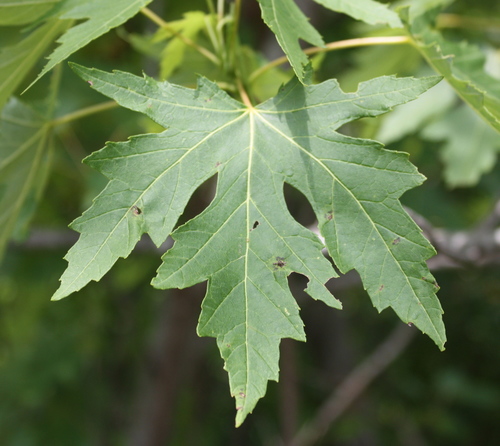
Acer saccharinum L., commonly known as silver maple, is a relatively fast-growing deciduous tree. It typically reaches 15–25 m (49–82 ft) in height, with exceptional specimens growing to 35 m (115 ft), and a usual spread of 11–15 m (36–49 ft) wide. A 10-year-old sapling is usually about 8 m (26 ft) tall. This tree is often found growing along waterways and in wetlands, which gives it the common colloquial name "water maple". It is highly adaptable, though it requires more sunlight than other maple species. Its leaves are simple with palmate venation, measuring 8–16 cm (3+1⁄4–6+1⁄4 in) long and 6–12 cm (2+1⁄4–4+3⁄4 in) wide, with deep angular notches between the five lobes. The slender 5–12 cm (2–4+3⁄4 in) long leaf stalks allow even a light breeze to expose the leaves' downy silver undersides, creating a striking visual effect. Compared to many other maples, silver maple has less pronounced autumn color, usually turning pale yellow, though some specimens produce more brilliant yellow, and even orange and red tones. The tree also tends to change leaf color and drop its leaves slightly earlier in autumn than other maples. It produces dense clusters of flowers in early spring, before leaves emerge, and its seeds mature in early summer. The fruit is a schizocarp made up of two single-seeded, winged samaras; each samara wing is around 3–5 cm (1+1⁄4–2 in) long. This species produces the largest fruit of any maple native to its range. While the wings allow some wind transport, the heavy fruit is also carried by water. Silver maple and its close relative red maple are the only Acer species that produce fruit crops in spring instead of fall. The seeds of both species have no epigeal dormancy and germinate immediately. Seed production begins when the tree is 11 years old, and large seed crops are produced most years. Like most maples, silver maple can be variably dioecious (with separate male and female trees) or monoecious (with both male and female flowers on the same tree), though dioecious trees are far more common, and individual trees can change sex from year to year. On mature trunks, the bark is gray and shaggy; on young trunks and branches, the bark is smooth and silvery gray. Wildlife uses silver maple in many ways. Across much of the eastern United States, the tree's large rounded buds are one of the primary spring food sources for squirrels, after most acorns and nuts have sprouted and squirrel food stores are depleted. Its seeds are also eaten by chipmunks and birds, while beaver and deer feed on its bark. The trunks often form cavities that provide shelter for squirrels, raccoons, opossums, owls and woodpeckers, and these cavities are often frequented by carpenter ants. The leaves are also a food source for various Lepidoptera species, including the rosy maple moth (Dryocampa rubicunda). Silver maple wood is used as pulp for paper production, and its lumber is used for furniture, cabinets, flooring, musical instruments, crates, and tool handles, as it is light and easily worked. Due to its fast growth, it is being researched as a potential source of biofuels. Silver maple produces sweet sap, but it is generally not used for commercial maple sugar production because its sugar content is lower than that of other maple species. Silver maple is often planted as an ornamental tree, valued for its rapid growth, ease of propagation and ease of transplanting. It is highly tolerant of urban conditions and is frequently planted alongside streets. However, its quick growth produces brittle wood that is commonly damaged during storms. It has a shallow, fibrous root system that easily invades septic fields and old drain pipes, and can crack sidewalks and foundations. It is a vigorous resprouter, and if not pruned, it often grows with multiple trunks. Though it naturally occurs near water, it can grow on drier ground when planted there. In ideal natural conditions, silver maple can live up to 130 years, but in urban environments it typically lives 80 years or less. After World War II, silver maples were commonly used as landscaping and street trees in suburban housing developments and cities, especially as a replacement for blighted American elms. They later fell out of favor for these uses due to their brittle wood, unattractive form when not pruned or trained, and tendency to produce large numbers of volunteer seedlings. Today, the tree has become so unpopular that some towns and cities have banned its use as a street tree. The natural range of silver maple covers most of the eastern and Midwestern United States, plus southern Canada (specifically southern Ontario and southwestern Quebec). It is generally absent from the humid U.S. coastal plain south of Maryland, so it is only found in the Appalachians in those southern states. It does not occur along the Gulf Coast or in Florida outside a few scattered locations in the Florida panhandle. It is commonly cultivated outside its native range, tolerates a wide range of climates, and grows successfully as far north as central Norway. It also grows in Anchorage, Alaska. It can thrive in Mediterranean climates, such as those of Jerusalem and Los Angeles, if provided with summer water. Silver maple is closely related to red maple (Acer rubrum) and can hybridize with it; the resulting hybrid is called Freeman maple (Acer × freemanii). Freeman maple is a popular ornamental tree for parks and large gardens, combining the fast growth of silver maple with the less brittle wood, less invasive roots, and bright beautiful fall foliage of red maple. The cultivar Acer × freemanii Autumn Blaze = 'Jeffersred' has received the Royal Horticultural Society's Award of Garden Merit. Silver maple is the preferred host of the maple bladder gall mite Vasates quadripedes.