About Acer pseudoplatanus L.
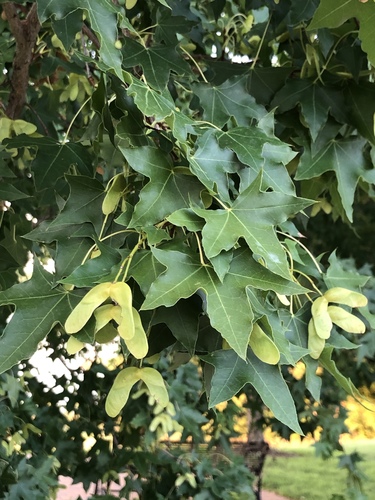
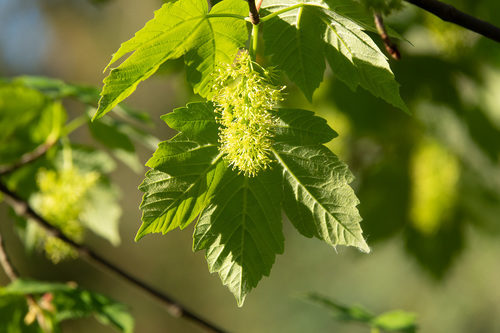
Acer pseudoplatanus L., commonly known as sycamore, is a large broad-leaved deciduous tree. At maturity, it reaches 20–35 m (66–115 ft) tall, with branches forming a broad, domed crown. Young trees have smooth grey bark that becomes rougher with age, breaking into scales to expose pale-brown-to-pinkish inner bark. Buds grow in opposite pairs, are ovoid (oval-shaped) and pointed, with green bud scales (modified leaves that protect the bud) edged and tipped dark brown, measuring 0.5–1 centimetre (1⁄4–3⁄8 in). When leaves are shed, they leave horseshoe-shaped leaf scars on the stem. Leaves are opposite and large, measuring 10 to 25 cm (4 to 10 in) in both length and breadth, with a palmate structure of 5 pointed, coarsely toothed or serrated lobes. They have a leathery texture with thick protruding veins on the underside, are dark green with a paler underside; some cultivars have purple-tinged or yellowish leaves. The leaf stalk (petiole) is 5 to 15 cm (2 to 6 in) long, often tinged red, with no stipules (leaf-like structures) at its base. Sycamore flowers are yellow-green, and can be functionally monoecious or dioecious. They bloom after leaves emerge in early summer (May or June in the British Isles), growing on pendulous panicles 10 to 20 cm (4 to 8 in) long, with roughly 60–100 flowers per stalk. The fruit consists of paired winged seeds called samaras: each seed is 5 to 10 mm (1⁄4 to 3⁄8 in) in diameter, with a 20 to 40 mm (3⁄4 to 1+5⁄8 in) long wing that develops as an extension of the ovary wall. The wings are held at roughly right angles to each other, which distinguishes sycamore samaras from those of other maple species: A. platanoides and A. campestre have almost opposite wings, while A. saccharum has almost parallel wings. When shed, the samara wing catches wind and rotates the fruit as it falls, slowing descent to allow wind to disperse the seed further from the parent tree. Seeds mature in autumn, around four months after pollination. Sycamore is tetraploid, with each cell holding four sets of chromosomes (2n=52), while A. campestre and A. platanoides are diploid (2 sets of chromosomes, 2n=26). Botanically, sycamore flowers grow in hanging branched panicles and include multiple flower types. Most are morphologically bisexual (with both male and female organs) but function as unisexual. Some are morphologically and functionally male, others are morphologically bisexual but function as males, and others are morphologically bisexual but function as females. All flower types can produce pollen, but pollen from functionally female flowers does not germinate. All flowers produce nectar, with functionally female flowers producing more nectar with a higher sugar content. Sycamore varies widely across its range and has strategies to prevent self-pollination, which reduces progeny genetic variation and may lower vigour. Most inflorescences contain a mix of functionally male and female flowers. On any single tree, one flower type opens first, and the other opens later. Some trees may be male-starters one year and female-starters another. The timing of sexual change can differ across different parts of the crown, and different trees in a population bloom over several weeks, which encourages cross-pollination, though self-pollination is not fully prevented. Sycamore can hybridize with other species in Acer section Acer where their natural ranges overlap, including A. heldreichii and A. velutinum. Intersectional hybrids with A. griseum (Acer section Trifoliata) are also recorded, with reduced basal leaf lobes that make leaves appear almost three-lobed (trifoliate). Sycamore is native to central and eastern Europe and western Asia. Its confirmed natural range includes Albania, Austria, Belgium, Bulgaria, Czech Republic, France, Georgia, Germany, Greece, Hungary, Italy, Lithuania, Netherlands, Poland, Portugal, Romania, southern Russia, Spain, Switzerland, East Thrace, and the former Yugoslavia. Reports of its presence in eastern Turkey are now known to refer to A. heldreichii subsp. trautvetteri. It was probably introduced to Britain by the Tudor period (before 1500), and was first recorded growing wild in 1632 in Kent. The date of first introduction to Ireland is unclear, but the oldest recorded specimen in Ireland (County Cavan) dates to the seventeenth century. It was introduced to Sweden around 1770, using seeds obtained from Holland. The lack of old native names for it has been used to argue it was not present in Britain before introduction around 1487, but this is challenged by the existence of an old Scottish Gaelic name for the tree, fior chrann, which suggests it may have been present in Scotland as early as the Gaelic settlement of Dál Riata in the late 6th and early 7th centuries. This would classify it as either an archaeophyte (naturalized, introduced before 1500) or possibly native if it reached Scotland without human intervention. Currently, it is typically classified as a neophyte, a naturalized plant introduced by humans in or after 1500. Today, sycamore is present in 3,461 (89.7%) of hectads in Britain, more than any native tree species. Sycamore has been introduced to suitable locations outside Europe as an ornamental tree for parks, streets, and gardens, including the United States, Canada, Australia (Victoria and Tasmania), Chile, New Zealand, Patagonia, and the laurel forests of Madeira and the Azores. At introduction, it was not recognized that its prolific seed production could allow it to spread and outcompete native species. Today it is considered an environmental weed in parts of Australia: the Yarra Ranges, Mount Macedon near Daylesford, and parts of the Dandenong Ranges in Victoria, where it is naturalized in eucalypt forests. It is also scattered in north-eastern Tasmania and at Taroona near the Derwent River in southern Hobart. It is classified as an invasive species in New Zealand, Norway, and environmentally sensitive locations in the United Kingdom. Sycamore was introduced to the United States around 1870, first planted in New York state and New Jersey. It was later cultivated as a park or street tree in New England and the Mid-Atlantic states. By the early 21st century, it was naturalized in 14 U.S. states (Connecticut, Delaware, Illinois, Kentucky, Maine, Michigan, North Carolina, New Jersey, New York, Pennsylvania, Rhode Island, and Washington, D.C.) and the Canadian provinces of British Columbia, New Brunswick, Nova Scotia, and Ontario. The United States Department of Agriculture considers it an invasive species. In its native range, sycamore is a natural component of birch (Betula sp.), beech (Fagus sp.), and fir (Abies sp.) forests. It readily invades disturbed habitats including forest plantations, abandoned farmland, brownfield land, railway lines, road verges, hedgerows, and native and semi-natural woodland. In New Zealand, it invades high country tussock grassland. As an introduced invasive species, it may degrade laurel forests in Madeira and Portugal, and is a potential threat to the rare endemic Madeiran orchid Dactylorhiza foliosa. It tolerates a wide range of soil types and pH levels, except heavy clay, and grows best on nutrient-rich, slightly calcareous soils. Sycamore roots form highly specific beneficial arbuscular mycorrhizal associations with the fungus Glomus hoi: the fungus grows within root tissues, forming branched tree-like structures inside root cortex cells, and promotes phosphorus uptake from the soil. The larvae of multiple moth species feed on sycamore leaves, including the sycamore moth (Acronicta aceris), the maple prominent (Ptilodon cucullina), and the plumed prominent (Ptilophora plumigera). The horse-chestnut leaf miner (Cameraria ohridella) occasionally lays eggs on sycamore, though 70% of larvae do not survive past the second instar. Sycamore leaves attract aphids, which in turn attract ladybirds and hoverflies that feed on the aphids. The flowers produce large amounts of nectar and pollen that attract bees and other insects, and seeds are eaten by small mammals such as voles and birds. As an introduced plant in Britain, sycamore has a relatively small associated insect fauna of around 15 species, but it hosts a wider range of leafhoppers than the native field maple. Sycamore may be attacked by the horse chestnut scale insect (Pulvinaria regalis), which sucks sap from the trunk and branches but does not cause serious damage. Sometimes squirrels strip bark from branches to girdle the stem, which can kill entire branches, leaving brown wilted leaves. The sycamore gall mite Eriophyes macrorhynchus produces small red galls on leaves of sycamore and field maple (Acer campestris) starting in April, similar to galls caused by the nail gall mite Eriophyes tiliae. Another mite, Aceria pseudoplatani, causes 'sycamore felt gall' on the underside of leaves of both sycamore and Norway maple (A. platanoides). The sycamore aphid Drepanosiphum platanoidis sucks sap from buds and foliage, producing large amounts of sticky honeydew that contaminates foliage, cars, and garden furniture beneath the tree. Sycamore is susceptible to sooty bark disease, caused by the fungus Cryptostroma corticale. This disease causes crown wilting and branch death. Rectangular patches of bark detach to expose thick layers of black fungal spores. The fungus can exist in the heartwood without symptoms for many years, moving toward the bark after long, hot summers. The spores are highly allergenic and cause a hypersensitivity pneumonitis called maple bark stripper's disease. A less serious condition, tar spot disease caused by the fungus Rhytisma acerinum, forms black spots with yellow margins on foliage. Leaves may fall prematurely, but the tree's overall vigour is largely unaffected. Sycamore leaf spot, caused by the fungus Cristulariella depraedans, produces pale blotches on leaves that later dry out and fall; this causes moderate leaf loss but has little long-term effect on the tree. The fungal species Coniothyrium ferrarisianum was also isolated from sycamore leaves in Italy in 1958. Horses that eat sycamore seeds or emergent seedlings can develop an often fatal condition called atypical myopathy. In cultivation, sycamore self-seeds very vigorously, with seeds germinating en masse in spring, leaving little to no seed bank in the soil. It is easily propagated from seed, but cultivars do not breed true. Special cultivars such as A. pseudoplatanus 'Brilliantissimum' are propagated via grafting. This cultivar is notable for the bright salmon-pink color of its young foliage, and is the only sycamore cultivar to receive the Royal Horticultural Society's Award of Garden Merit. A rare weeping cultivar with dangling branches, A. pseudoplatanus var. pendulum, was first sold by Knight & Perry's exotic nursery in Chelsea, England before 1850, when the name was published by W.H. Baxter in the Supplement to Loudon's Hortus Brittanicus, but no known specimens of this cultivar survive. Sycamore is known for its tolerance of wind, urban pollution, salt spray, and low summer temperatures, which makes it a popular tree for planting in cities, along roads treated with salt in winter, and in coastal areas. It is cultivated and widely naturalized north of its native range in Northern Europe, notably in the British Isles and Scandinavia as far north as Tromsø, Norway (seeds can ripen as far north as Vesterålen), Reykjavík Iceland, and Tórshavn on the Faroe Islands. It now grows throughout the British Isles, after being probably introduced in the 16th century. Sycamore produces new growth from stumps or roots after being cut down, so it can be coppiced to produce poles and other small timber. Coppice stools grow comparatively quickly, reaching up to 1.3 metres (4 ft 3 in) in length in the first year after harvesting. It is also grown as a medium-to-large bonsai species in many parts of Europe, where fine specimens can be found. For uses, sycamore is planted ornamentally in parks, and sometimes used as a street tree, as its tolerance of air pollution makes it suitable for urban plantings. Due to its wind tolerance, it has often been planted in coastal and exposed areas as a windbreak. It produces hard-wearing, white or cream close-grained timber that turns golden with age. The wood can be cut and worked in any direction, and is used to make musical instruments, furniture, joinery, wood flooring, and parquetry. Because it does not stain, it is used for kitchen utensils including wooden spoons, bowls, rolling pins, and chopping boards. In Scotland, it has traditionally been used to make fine boxes, often paired with contrasting dark laburnum wood. Occasionally, trees produce wood with wavy grain, which greatly increases its value for decorative veneers. As a hardwood, it has a medium weight of 630 kg per cubic metre. It is a traditional wood for making the backs, necks, and scrolls of violins; wavy-grained wood is often marketed as rippled sycamore. Straight twigs can be used to make whistles when rising sap allows the bark to be separated; these whistles and sycamore branches are used in early May customs in Cornwall. The wood is used for fuel: it is easy to saw and split with an axe, and produces a hot flame and good embers when burned. In Scotland, sycamores were once a preferred tree for hangings, because their lower branches rarely broke under the strain. Both male and female sycamore flowers produce abundant nectar, which makes a fragrant, delicately flavored, pale-colored honey. Nectar and copious dull yellow ochre pollen are collected by honeybees as food. Sap rises vigorously in spring, and like sugar maple sap, it can be tapped to make a refreshing drink, serve as a sugar source, or be processed into syrup or beer.