About Acer pensylvanicum L.
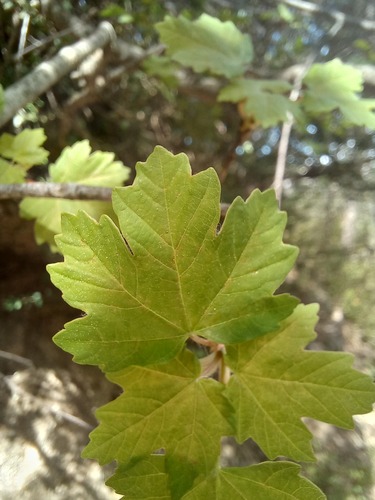
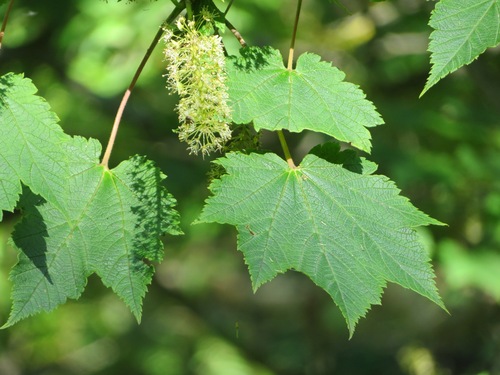
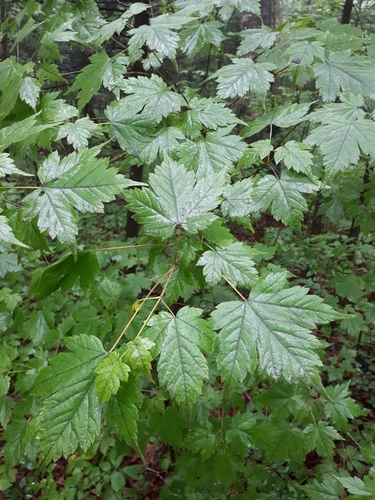
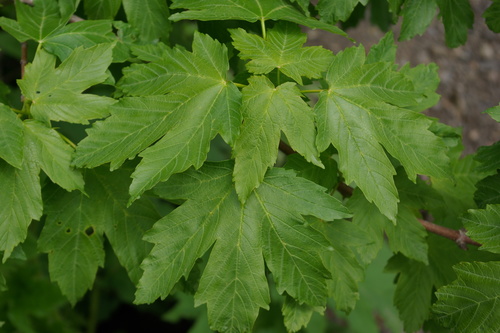
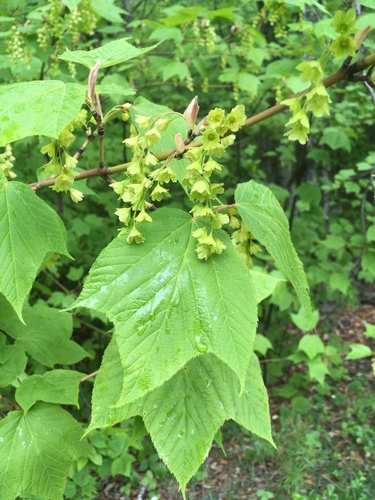
Acer pensylvanicum L., commonly called striped maple, is a large shrub or small deciduous tree that reaches 5–10 meters (16–33 ft) tall, with a trunk up to 20 cm (8 in) in diameter. It has a broadly columnar form, with a short, forked trunk that splits into arching branches that form an uneven, flat-topped crown. Striped maple blooms in late spring, producing yellowish-green, bell-shaped inflorescences that hang in long, slender clusters at the tips of branches. This species is most often dioecious, though monoecy can also occur. Striped maple trees can change their sex, and this change appears to happen in response to environmental conditions. One study found that most sex changes were from male to female; female trees are generally less vigorous, and a significant portion of female trees die at the end of the growing season. Young striped maple bark is smooth gray-green with distinct white vertical striping. As the tree ages, the bark becomes brownish or grayish green, while the stripes darken, fade to a reddish-brown color, and may disappear entirely with advanced age. Its leaves are broad and soft, 8–15 cm (3–6 in) long and 6–12 cm (2.5–4.5 in) wide, with finely serrated edges and three shallow forward-pointing lobes. Leaves emerge in spring with a pink tinge, mature to dark green in summer, and turn bright yellow in autumn. The fruit produced by striped maple is a samara. Its seeds are approximately 27 mm (1.1 in) long and 11 mm (0.43 in) wide, with a wing angle of 145° and a noticeably veined pedicel. Samaras ripen and disperse in late summer or early fall, changing color from faint red to tan or light brown. The natural range of striped maple stretches from Nova Scotia and the Gaspé Peninsula of Quebec, west to southern Ontario, Michigan, and Saskatchewan; south to northeastern Ohio, Pennsylvania, and New Jersey, and along the Appalachian Mountains as far south as northern Georgia. It was introduced to England in 1760 as an ornamental plant, and to continental Europe soon after. Striped maple grows well in a wide variety of soils and tolerates nutrient-poor, leached soils, but it is most often found on well-drained, moist, sandy loams, and grows best on shaded, cool northerly slopes of deep valleys. Striped maple is an understory tree of cool, moist forests, and often favors slopes. It is among the most shade-tolerant deciduous trees, and is well adapted to heavy shade. It can germinate and persist for years as a small understory shrub, then grow quickly to its full height when a canopy gap opens. It never grows tall enough to become a canopy tree, however, and once the gap above closes through forest succession, it responds by producing abundant flowers and fruit, and spreads to some degree via vegetative reproduction. Many mammal species including moose, deer, beavers, porcupines, and rabbits eat striped maple’s twigs, buds, seeds, and bark, especially during winter. Ruffed grouse feed on its samaras and buds. Woodland caribou browse the species during summer, and beavers will eat striped maple when their preferred food species are not available. As an understory shrub or tree, striped maple contributes to forest habitat by creating vertical diversity in the canopy. It is susceptible to Verticillium wilt caused by Verticillium albo-atrum, and gray mold spot caused by Cristulariella depraedens. A specific type of Pezicula trunk and branch canker, Pezicula subcarnea, has been observed to only attack striped maple. It can also become infested by Agrilus politus, a flatheaded borer beetle that forms stem galls on the tree. Unique among trees per USDA records, striped maple is the only tree that is both fire resistant and has a medium tolerance to fire. Striped maple is uncommonly cultivated as an ornamental plant, grown for its distinctive striped bark and bright fall color. Its best known cultivar is 'Erythrocladium', which has bright coral or salmon-red twigs, and bright pink or reddish bark during winter. This cultivar was discovered in Germany around 1904, but is uncommon commercially because it is difficult to propagate. Several Northeastern Woodlands Indigenous tribes have used striped maple for both medicinal and material purposes. The Penobscot of Maine call this species atohkímosi, and use a poultice made from steeped bark to reduce limb swelling. They also include it in compound infusions to treat hemoptysis, kidney problems, and venereal disease. The Haudenosaunee use decoctions containing striped maple bark as an emetic and laxative. The Mi'kmaq call the species wapoq, and use bark decoctions for a range of respiratory issues, and also as a beverage. The Ojibwe use the bark as an emetic; the Bois Forte Band of Chippewa (Zagaakwaandagowininiwag), a northern Minnesota Ojibwe band, are recorded to have used striped maple wood to make arrows and dice bowls. One of the species’ common names, whistlewood, comes from the practice of carving whistles from its bark and branches. Colonial-era Canadian and American farmers reportedly fed cattle dried striped maple leaves in winter, and turned horses and cows out into woodlands to browse on new shoots and buds in spring.