About Acer palmatum Thunb.
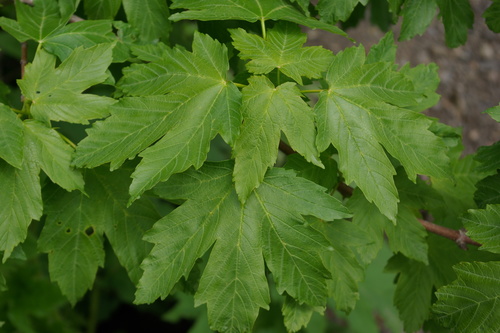
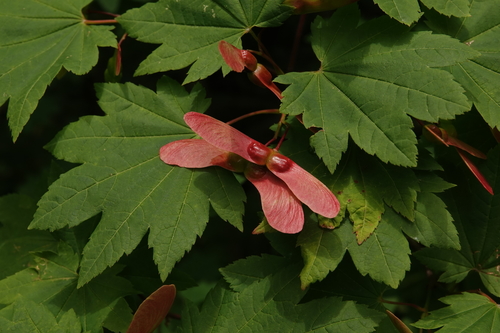
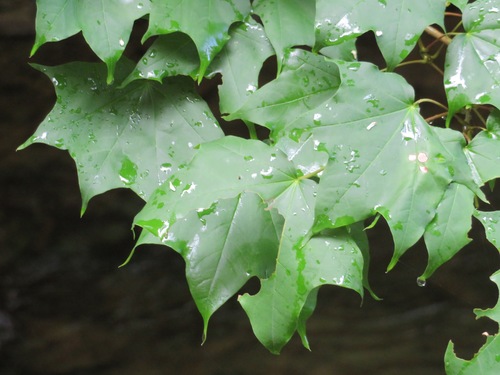
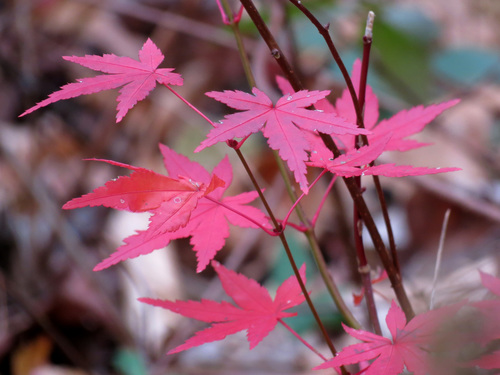
Acer palmatum Thunb. is a deciduous plant that grows as a shrub or small tree. It typically reaches 6 to 10 meters (20 to 33 feet) in height, and rarely grows up to 16 meters (52 feet). Its mature width ranges from 4.5 to 10 meters (15 to 33 feet). In its native habitat, it often grows as an understory plant in shady woodlands, and may have multiple trunks that join close to the ground. When mature, its canopy often forms a dome-like shape. Its leaves are 4 to 12 centimeters (1+1⁄2 to 4+3⁄4 inches) in both length and width, and are palmately lobed with five, seven, or nine sharply pointed lobes. It produces small cymes of flowers, with individual flowers having five red or purple sepals and five whitish petals. Its fruit is a pair of winged samaras: each samara is 2 to 3 centimeters (3⁄4 to 1+1⁄4 inches) long and holds a 6 to 8 millimeter (1⁄4 to 5⁄16 inch) seed. Seeds of Acer palmatum and similar species require stratification to germinate. Even in wild populations, Acer palmatum shows substantial genetic variation: seedlings from the same parent tree usually differ in traits like leaf size, shape, and color, and the overall tree form can range from upright to weeping. Three subspecies of Acer palmatum are currently recognized: Acer palmatum subsp. palmatum: It has small leaves 4–7 cm (1+1⁄2–2+3⁄4 in) wide, with five or seven lobes and double-serrate margins; its seed wings are 10–15 mm (3⁄8–5⁄8 in) long, and it grows at lower altitudes across central and southern Japan (not found in Hokkaido). Acer palmatum subsp. amoenum (Carrière) H.Hara: It has larger leaves 6–12 cm (2+1⁄4–4+3⁄4 in) wide, with seven or nine lobes and single-serrate margins; its seed wings are 20–25 mm (3⁄4–1 in) long, and it grows at higher altitudes across Japan and South Korea. Acer palmatum subsp. matsumurae Koidz: It has larger leaves 6–12 cm (2+1⁄4–4+3⁄4 in) wide, with seven (rarely five or nine) lobes and double-serrate margins; its seed wings are 15–25 mm (5⁄8–1 in) long, and it grows at higher altitudes across Japan.
Acer palmatum has been cultivated in Japan for centuries, and has been grown in temperate regions around the world since the 1800s. The first specimen of this tree arrived in Britain in 1821. In the late 18th century, Swedish doctor-botanist Carl Peter Thunberg traveled in Japan and created drawings of this small tree that later became iconic to oriental garden design. He gave it the species epithet palmatum after the hand-like shape of its leaves, which matches the traditional Japanese names kaede and momiji that refer to the 'hands' of frogs and babies respectively. Japanese horticulturists have long developed cultivars from maples found in Japan and nearby Korea and China. Acer palmatum is a popular choice for bonsai enthusiasts and has long been a common subject in art. Numerous cultivars are popular in Europe and North America, with red-leafed cultivars being the most favored, followed by cascading green shrubs with deeply dissected leaves. There are thousands of named Acer palmatum cultivars, with a wide range of forms, colors, leaf types, sizes, and preferred growing conditions. Mature cultivars can range in height from 0.5 to 25 meters (1 1⁄2 to 82 feet) depending on the type. Preparations made from Acer palmatum branches and leaves are used as a treatment in traditional Chinese medicine. Its leaves are edible; momiji tempura, a local dish from Minoh, is made by pickling the leaves for a year, then coating them in flour, sesame seeds and sugar and deep frying them.