About Acer mandshuricum Maxim.
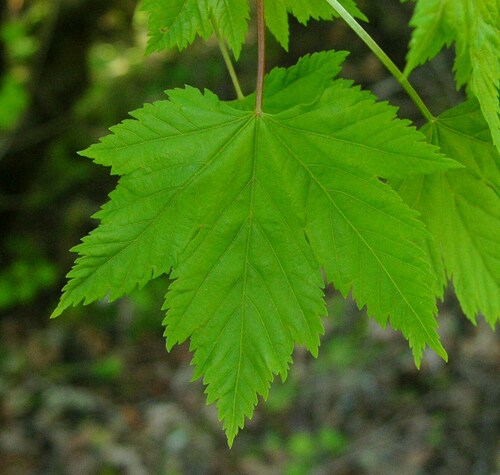
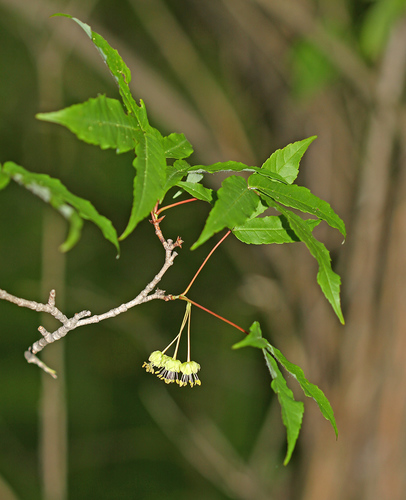
Acer mandshuricum Maxim. is a slender deciduous tree that grows up to 30 meters tall, though it is usually smaller. It is a trifoliate maple related to Acer triflorum (three-flower maple) and Acer griseum (paperbark maple). Unlike these two related species, which have exfoliating bark, Acer mandshuricum has smooth, gray bark. Its leaves have 7–10 cm (3–4 in) long petioles and three leaflets. The leaflets are short-stalked and oblong, 5–10 cm (2–4 in) long and 1.5–3 cm (0.5–1 in) broad, with serrated margins. The central leaflet is the same size as or slightly larger than the two side leaflets. This tree leafs out early in spring, and throughout the growing season its deep green leaves contrast with red petioles. Its flowers are yellowish-green, and grow in corymbs containing three to five flowers. The hard, horizontally spreading samaras are 3–3.5 cm long and 1 cm broad. This species was first introduced to cultivation in 1904, when trees were planted at the Royal Botanic Gardens, Kew in Britain. It has not performed very well in cultivation in Britain, because it is adapted to a continental climate. Its early spring leafing means new growth is often damaged by late frosts there, and the largest recorded specimen in the British Isles (per the Tree Register of the British Isles) is only 8 metres tall. Although it is rarely cultivated outside of arboreta, its narrow growth habit makes it suitable for small gardens. Like its close relatives, it produces spectacular fall color in shades of pink and orange. It grows best in full sun to partial shade, in moist, well-drained soil that ranges from acid to neutral. In the United States, mature specimens can be seen at Arnold Arboretum in Boston, Massachusetts. This includes a 70-year-old specimen that has reached approximately 13 m (43 ft) tall and 8 m (26 ft) wide. In Canada, the Royal Botanical Gardens in Hamilton, Ontario hold three Manchurian maples, each about 10 m (33 ft) tall.