About Acer leucoderme Small
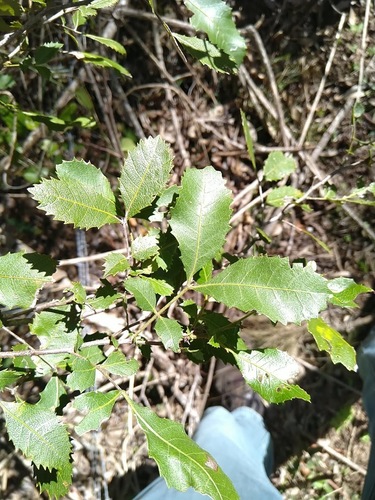
Chalk maple, scientifically named Acer leucoderme Small, is a small tree that reaches 8 to 9 meters in height. It grows into a rounded shape with slender branches, and often forms multiple trunks. Both the common name "chalk maple" and the scientific epithet leucoderme (meaning "white skin") refer to the attractive, smooth, thin chalky white or light gray bark found on mature trees. As the bark ages, it becomes ridged and blackish at the base of the trunk. The leaves of chalk maple are opposite and simple, measuring 5 to 9 centimeters long and wide, and often droop at the tip. Leaves have 3 or 5 long-pointed lobes with wavy or coarsely toothed edges. The upper surface of the leaf is dark green and hairless, while the underside is yellow-green and covered in soft hairs. In autumn, leaves turn colors ranging from brilliant yellow to orange to deep red. Its fruit is a paired brown samara, 2 to 2.5 centimeters long, that matures in autumn.
Acer leucoderme is often confused with Acer floridanum, the Florida maple, but has several key differences. A. leucoderme is smaller overall than Florida maple, but produces larger leaves. The underside of A. leucoderme leaves is yellow-green, rather than the whitish underside seen in Florida maple, and the leaf lobes of Florida maple are squarer and blunter than the long-pointed lobes of A. leucoderme. Some botanists classify A. leucoderme as a subspecies of sugar maple, named A. saccharum subsp. leucoderme.
Acer leucoderme is distributed from North Carolina south to Florida, and west to Texas. It grows as an understory tree, and can survive in poor soil conditions. Its natural habitats include cliffs, river banks, and ravines. Though it is a relatively uncommon species, the IUCN Red List categorizes A. leucoderme as Least Concern, and its population is considered stable.
Acer leucoderme is well suited to the warmer, drier climates of upland regions in the southeastern United States. Because it does not need rich soil to grow, it is a viable option for planting in urban environments. It can be grown as a shade tree or a reclamation plant as far north as USDA plant hardiness zone 5B, well outside its native range. The tree is highly tolerant of shade and drought. It is recommended to collect chalk maple seeds while they are still on the parent tree, because seeds do not remain viable for long and are susceptible to insect damage. Acer leucoderme is primarily used as an ornamental tree, though it has also been used as a minor timber tree.