About Acer japonicum Thunb.
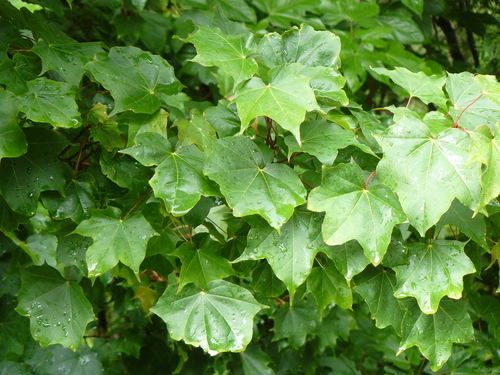
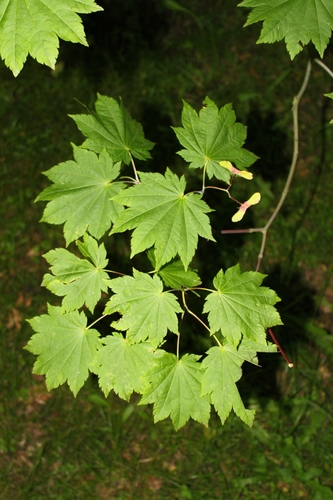
Acer japonicum Thunb. is a small deciduous tree that grows 5–10 m tall, rarely reaching 15 m, with a trunk up to 40 cm in diameter. Bark is smooth on young trees, becoming rough and scaly on older trees. Shoots are slender and thinly covered in whitish downy hairs. Leaves are rounded, 7–15 cm in diameter, with 9–13, rarely 7, serrate lobes cut to half or less of the leaf diameter. New leaves are downy with white hairs; most hairs are lost by late summer, remaining only on veins and the leaf underside. The petiole is 2–4 cm long and hairy. In autumn, leaves turn bright orange to dark red. Flowers are 1 cm in diameter, dark purplish-red with five sepals and petals, produced in groups of 10–15 in drooping corymbs in early spring as leaves begin to open. The fruit is a paired samara with 7 mm diameter nutlets and 20–25 mm long wings, hanging under the leaves. Acer japonicum is frequently cultivated as an ornamental plant in temperate regions of Europe, North America, and elsewhere, though it is much less common in cultivation than Acer palmatum. In cultivation, it often grows as a shrubby tree with multiple trunks joined at ground level. It prefers growing conditions similar to Acer palmatum, but is sometimes considered more tolerant of cold, especially compared to the more delicate cultivars of Acer palmatum. Numerous cultivars have been selected, and some have their own common names: for example, Acer japonicum 'Vitifolium' is called "grape-leaf maple". Other popular cultivars are 'Aconitifolium, "downy Japanese maple", which has deeply incised leaves, and 'Green Cascade', which has drooping to pendulous branches. All three cultivars have received the Royal Horticultural Society's Award of Garden Merit. Due to variation from the wild species, some cultivars are hard to assign to the correct species, and have often been mislabeled as cultivars of other related species; most notably, 'Aureum' is commonly cited as a cultivar of Acer japonicum, but is actually derived from Acer shirasawanum. Cultivars of this maple appear in almost every maple collection, including Esveld Aceretum in Boskoop, Netherlands and the large Acer section of Arnold Arboretum in Boston, Massachusetts, USA. They are also common in general horticultural collections, such as Valley Gardens in Surrey, England.