About Acer griseum (Franch.) Pax
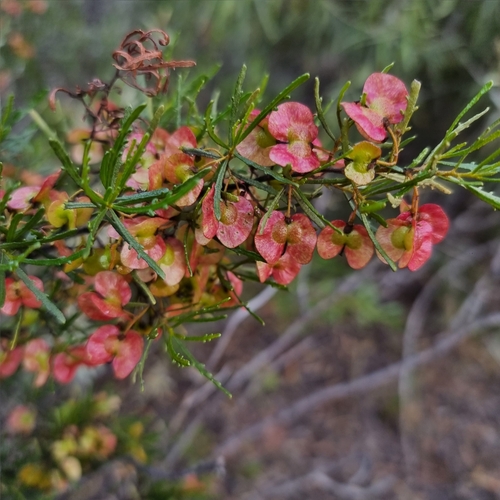
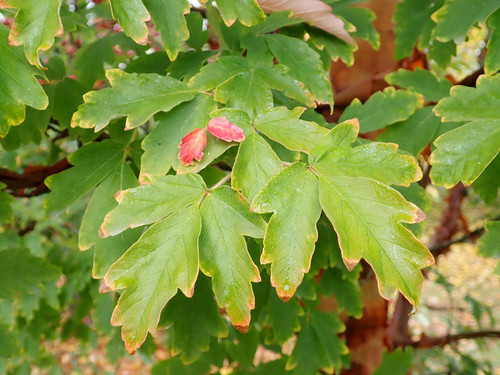
Acer griseum (Franch.) Pax is a small to medium-sized deciduous tree, reaching 6–9 m (20–30 ft) tall and 5–6 m (16–20 ft) wide, with a trunk up to 70 cm (28 in) in circumference. Its bark is smooth, shiny orange-red, and peels in thin, papery layers; older trees may develop fissured bark. Young shoots are densely covered in fine downy fuzz, which wears away by the second or third year, while bark exfoliates by the third or fourth year. Leaves are compound, growing from a 2–4 cm petiole and bearing three leaflets. Each leaflet is 3–10 cm long and 2–6 cm broad, with a dark green upper surface, bright glaucous blue-green lower surface, and several blunt teeth along the margins. Its yellow flowers are androdioecious, borne in small hanging corymbs during spring. The fruit is a paired samara with two winged seeds; each seed is about 1 cm long, with a 3 cm wing. Acer griseum was first brought into cultivation in Europe in 1901 by Ernest Henry Wilson for Veitch Nurseries in the UK, and was introduced to North America shortly after. It is a maple species widely grown as an ornamental plant in temperate regions. It is prized for its decorative exfoliating bark; translucent pieces of this bark often remain attached to branches until they wear away. It also produces striking autumn foliage that can show red, orange and pink tones. Cultivars of this species include the columnar 'Copper Rocket'. This plant has received the Royal Horticultural Society's Award of Garden Merit. In 2015, the North America-China Plant Exploration Consortium (NACPEC) ran an expedition specifically targeting Acer griseum for seed collection, with the goal of increasing the genetic diversity of cultivated plants. Propagation of Acer griseum is somewhat difficult, because its seeds have the same parthenocarpic tendencies as the seeds of Acer maximowiczianum.