About Acer glabrum Torr.
Acer glabrum Torr. is most often a small tree, growing 6 to 9 meters (20 to 30 feet) tall, and can exceptionally reach 12 meters (39 feet) tall. Its trunk typically measures around 13 centimeters (5 inches) in diameter, and can exceptionally reach around 25 centimeters (10 inches) in diameter.
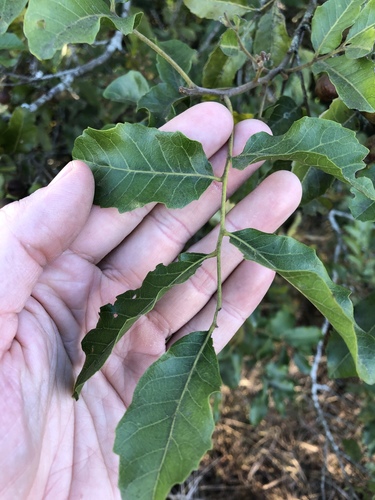
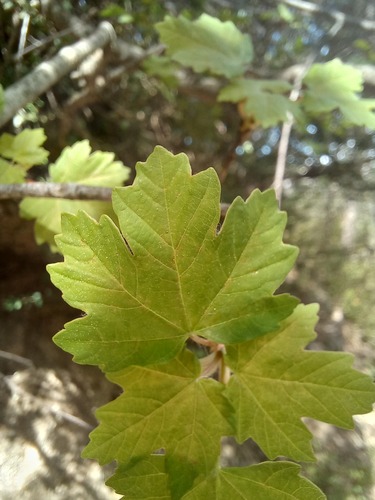
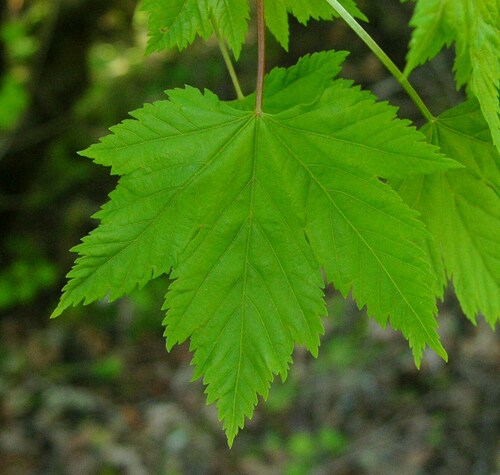
Its leaves are 2 to 13 centimeters (3⁄4 to 5 inches) broad, and are most often three-lobed, rarely five-lobed. The depth of the leaf lobing is variable; occasionally leaves are so deeply lobed that they become divided into three leaflets. The leaf lobes have an acute apex and a coarsely serrated margin. Yellowish-green flowers are produced in corymbs of five to ten flowers, and emerge at the same time as new leaves in spring. The fruit is a winged seed called a samara, which develops in fused pairs. When mature, the paired samaras are typically held at an angle of less than 45°, though some varieties may have pairs that spread to a 90° angle.
Acer glabrum is abundant across many parts of the Rocky Mountains, Cascade Mountains, Olympic Mountains, and Sierra Nevada. It often grows alongside ponderosa pine, Douglas-fir, and quaking aspen, and can be found in dry rocky areas. It tends to grow in brush fields that form in sites disturbed by fire. In well-established forested areas, conifers usually replace Acer glabrum. Its foliage is browsed by game animals, especially deer and elk during winter, as well as by cattle and sheep.
Native Americans used the species' strong stems to make snowshoe frames, bows, and other items. Some Plateau Indian tribes drink an infusion of this species, also called Douglas maple, as a treatment for diarrhea. Ramah Navajo people use an infusion of the glabrum variety to treat swellings, and also use it as a "life medicine" or panacea.