About Acer floridanum hort. ex K.Koch, 1869
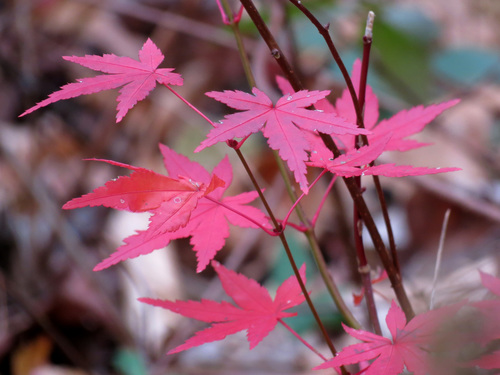
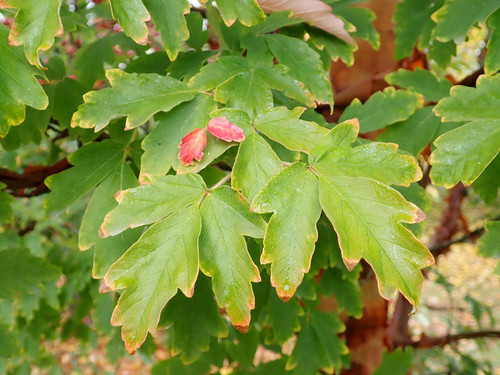
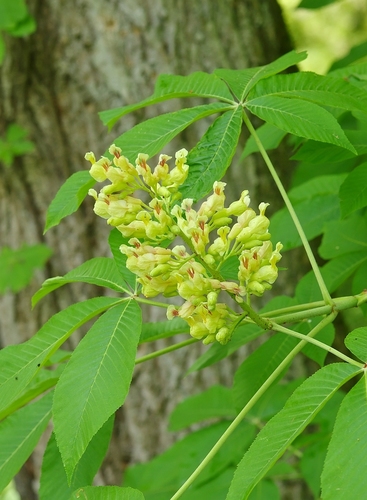
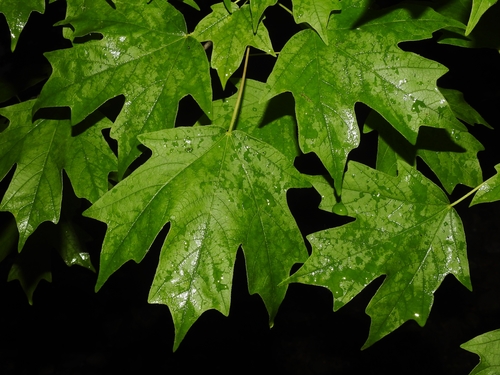
Acer floridanum hort. ex K.Koch, 1869 is a medium-sized to large deciduous tree that grows 15 to 25 m tall, reaching a maximum exceptional height of 38 m. It has an elliptical crown of moderate density with a smooth or rounded outline. Its bark is light gray with thick irregular curling ridges, and tends to become plated as the tree matures. Twigs are slender, somewhat shiny, and reddish brown. Terminal buds are sharply pointed, brown, and pubescent. Leaves are opposite, simple, palmately lobed and veined, 3–9.5 cm long and 3.5–11 cm broad, with an entire margin, three or five somewhat rounded lobes, and a 2–8 cm long petiole. Leaves are green on the upper surface, paler and pubescent on the lower surface, and turn orange and yellow in fall. Flowers are regular, pentamerous, quite small, and borne on yellow-green corymbs. They hang from puberulent pedicels 2.4–5 cm long in small clusters, appearing before or alongside new leaves in early spring, roughly two weeks before Acer saccharum flowers mature. This species is generally dioecious, though individuals are often also polygamous, meaning they produce both bisexual and unisexual flowers on the same plant. Its fruit is a paired samara 1.5–3 cm long.
Acer floridanum can easily be confused in the field with closely related species Acer leucoderme and Acer saccharum. It can be distinguished from A. saccharum by its smaller leaves with short, acute lobes, smaller samaras, and more whitish bark. Genetic overlap between these two species has been found in east Texas and in the zone stretching from Maryland south to northern Florida, even though Maryland is outside the natural range of A. floridanum, which suggests the two species hybridize. From A. leucoderme, it can be best told apart by the white hairs on the undersides of its leaves, while A. leucoderme has yellow leaf hairs.
This species has a discontinuous distribution across the Piedmont and Atlantic Coastal Plain, ranging from southeastern Virginia southwest across North Carolina, South Carolina, and Georgia into the Florida Panhandle. Its range extends further west across Alabama, Mississippi, and Louisiana into eastern Texas, and north through Arkansas into eastern Oklahoma. It also occurs in several isolated locations roughly halfway down the Gulf Coast of the Florida peninsula, at least one location in central Oklahoma, and additional isolated locations in Illinois, Missouri, Tennessee, and Kentucky.
Within its native range, average annual rainfall ranges from 112 to 163 cm (44 to 64 in), and the driest months average no less than 50 mm (2.0 in). January temperatures within the range normally reach a maximum of 11 to 18 °C (52 to 64 °F) and minimum of −2 to 7 °C (28 to 45 °F), while July temperatures normally reach a maximum of 29 to 33 °C (84 to 91 °F) and minimum of 21 to 24 °C (70 to 75 °F). This tree favors moist, well-drained fertile soils, particularly on stream terraces, in coves, and on adjacent bluffs and ridgetops. It grows best on soils containing calcareous material such as limestone or marl. It also grows well in the densely forested hammocks of Florida, which gives it the alternative common name hammock maple. It is most often confined to the understory.
While not overwhelmingly popular in cultivation, it is sometimes used as a shade tree in the Southern United States, due to its round crown and greater heat resistance compared to the more widely grown sugar maple. Several species of birds, and especially squirrels, use this tree as a nesting site and consume its seeds as food. Though Florida maple is not harvested as a commercial timber species on its own, it is harvested alongside commercial associate species for use as pulpwood, sawtimber, or wood veneer stock. It is classified as a hard maple, and high quality individuals can be used to produce furniture, flooring, paneling, and shoe lasts. However, its relative scarcity, small size, and generally poor shape usually limit its use to factory and box lumber, and even this use is only occasional. It has been growing in popularity as an ornamental or shade tree, especially in the Southern United States, due to its high heat resistance. It can also be used as a source of maple syrup, though its small size and rarity limit this use, especially compared to the commercially established sugar maple.