About Acer caudatifolium Hayata
Scientific name: Acer caudatifolium Hayata
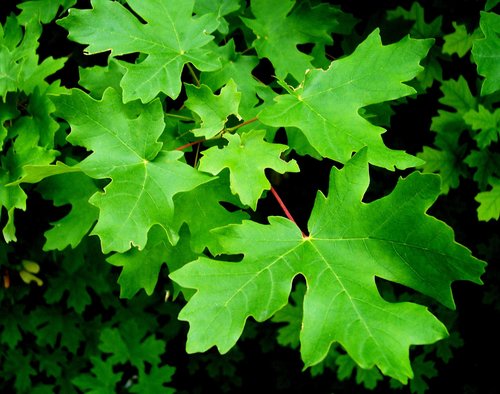
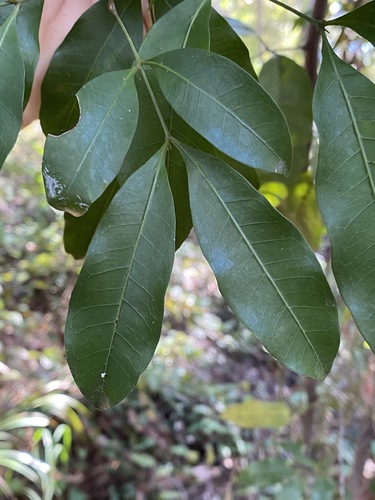
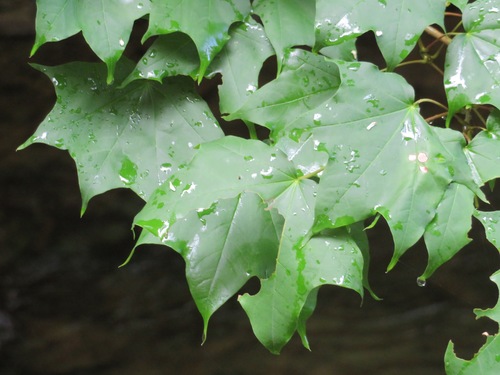
Description This species is a deciduous tree that can reach up to 20 m (66 ft) in height, and has thin, glabrous branches. Its leaves are arranged oppositely, are chartaceous, simple, and shaped ovate or ovate-elliptic. They measure 6–10 cm (2.4–3.9 in) in length and 3–5 cm (1.2–2.0 in) in width. The leaf base is rounded or slightly cordate, with finely serrated margins; leaves are usually unlobed or shallowly 3-lobed, and rarely conspicuously 3-5 lobed. The leaf apex is caudate-acuminate. The adaxial surface of the leaf blade is green, while the abaxial surface is light green.
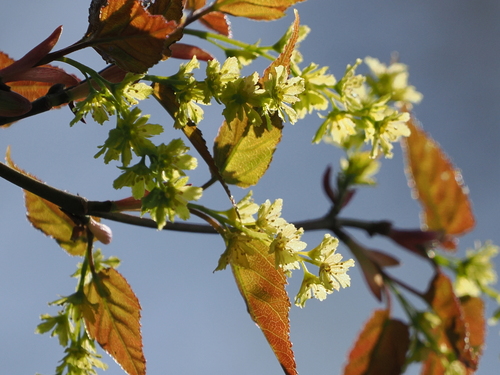
This species is monoecious, with unisexual flowers. Its inflorescence is a glabrous or short-pubescent raceme approximately 5 cm (2.0 in) long. Flowers are approximately 9 to 10 mm (0.35 to 0.39 in) wide, slender, and glabrous. The calyx bears 5 ovate-lanceolate glabrous sepals. There are 5 white rhomboid petals with undulating margins. The floral disk is thick and shallowly 8-lobed.
In female flowers, the pistil has a distinct carpel, and the ovary has a wing-like structure. The style is 2-fid, connate at the base and curved downward at the apex. Staminodes in female flowers are about 2 mm (0.079 in) in length. In male flowers, 8 stamens surround the floral disk, with filaments approximately 3 mm (0.12 in) in length, and staminodes are approximately 2 mm (0.079 in) in length.
Mature samarae are yellowish brown, with sickle-shaped wings approximately 3 cm (1.2 in) in length. The angle between the lower margins of the two wings is approximately 120–130 degrees.
Distribution and habitat This species is endemic to Taiwan. It mainly grows in forests at mid to high elevations of the Central Mountain Range, often growing mixed with hinoki cypress in the cloud zone. It is also naturally distributed in Yangmingshan, northern Taiwan, at elevations of 650–900 meters.