About Acer campestre L.
Scientific name: Acer campestre L.
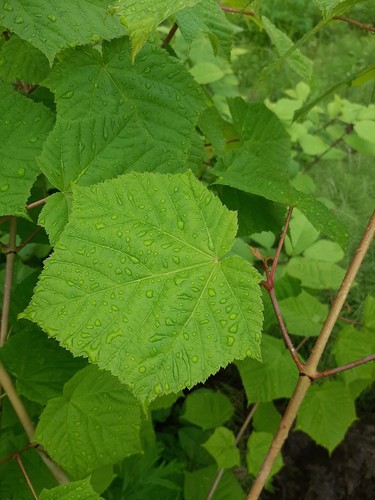
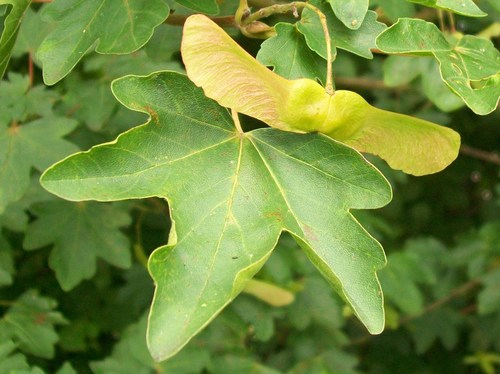
Description Acer campestre L. (common names: field maple, hedge maple in North America, occasionally common maple in Australia, locally known as dog oak in Nottinghamshire, England) is a deciduous tree. It reaches 15–25 m (49–82 ft) tall, with a trunk up to 1 m (3 ft 3 in) in diameter, and has finely fissured, often somewhat corky bark. Shoots are brown, with dark brown winter buds. Leaves grow in opposite pairs, are 5–16 cm (2.0–6.3 in) long (including the 3–9 cm (1.2–3.5 in) petiole) and 5–10 cm (2.0–3.9 in) broad, with five blunt, rounded lobes and a smooth margin. This species is usually monoecious. Yellow-green flowers form in spring at the same time that leaves open, arranged in erect clusters 4–6 cm (1.6–2.4 in) across, and are pollinated by insects. The fruit is a samara, with two winged achenes aligned at 180°; each achene is 8–10 mm (0.31–0.39 in) wide, flat, with a 2 cm (0.79 in) wing. Two varieties are recognized by some, but not all, authorities: Acer campestre var. campestre, which produces downy fruit; and Acer campestre var. leiocarpum (Opiz) Wallr. (synonym: A. campestre subsp. leiocarpum), which produces hairless fruit. The closely related species Acer miyabei replaces A. campestre in eastern Asia.
Distribution The native range of field maple covers much of Europe (including Denmark, Poland, Belarus, and England extending north to southern Scotland, where it is the only native maple), southwest Asia from Turkey to the Caucasus, and north Africa in the Atlas Mountains. Widespread planting and introductions have obscured the original native range in many areas. It has become locally naturalised in parts of the United States, and more rarely in New Zealand.
Ecology Field maple is an intermediate species in the ecological succession of disturbed areas. It is typically not among the first trees to colonise a freshly disturbed area, and instead seeds in under existing vegetation. It is very shade-tolerant during its early life stages, but requires higher light levels during its seed-bearing years. It grows rapidly initially, but is eventually overtaken and replaced by other trees as the forest matures. It is most commonly found on neutral to alkaline soils, and only occurs more rarely on acidic soils. Reported diseases affecting this species include leaf spot caused by the fungus Didymosporina aceris, mildew caused by Uncinula bicornis, canker caused by Nectria galligena, and verticillium wilt caused by Verticillium alboatrum. Leaves are also sometimes damaged by gall mites of the genus Aceria, and the aphid Periphyllus villosus.
Cultivation Field maple is widely grown as an ornamental tree in parks and large gardens. Its wood is white, hard and strong, and is used to make furniture, flooring, for wood turning and for musical instruments. However, the small tree size and relatively slow growth of the species mean it is an unimportant source of timber. It has an OPALS rating of 7. The hybrid maple Acer × zoeschense has A. campestre as one of its parent species. This tree has been awarded the Royal Horticultural Society's Award of Garden Merit.