About Acer buergerianum Miq.
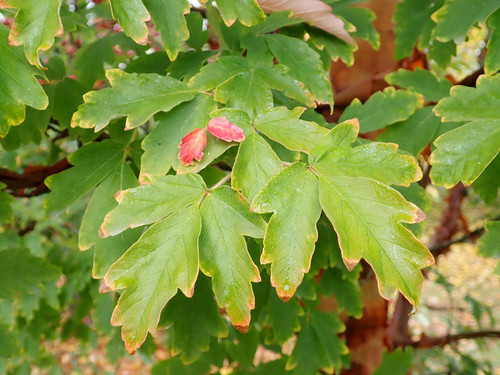
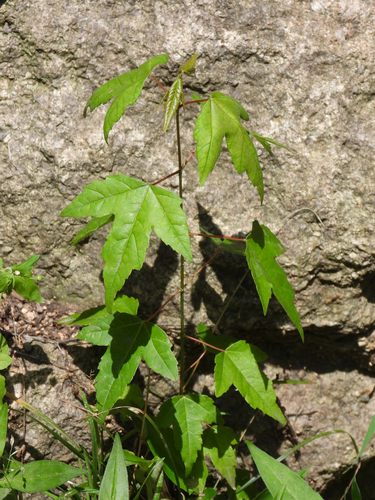
Acer buergerianum Miq. is a small to medium-sized deciduous tree. It grows 5 to 20 meters tall, with a trunk that can reach up to 50 cm in diameter. Its leaves grow in opposite pairs; excluding the 2–5 cm petiole, leaves are 2.5–8 cm long and 3.5–6.5 cm broad. The leaves are hard, with a glossy dark green upper surface and a paler lower surface, and most are three-lobed. On mature trees, these lobes point forward and have smooth margins, while on young trees lobes are more spreading and have serrated margins. It produces small yellow-green flowers in spring, arranged in pendulous corymbs. Each flower has five greenish sepals, five yellow-white petals around 2 mm long, and eight stamens. Its fruit is a samara made of two winged seeds. Each seed measures 4–7 mm in diameter, with a 15 mm wing; the wings point forward and often overlap each other. This species is naturally variable, and a number of varieties have been formally described. Acer buergerianum var. buergerianum is found in Hubei, Hunan, Jiangsu, Jiangxi, Shandong, and Zhejiang. Acer buergerianum var. jiujiangense Z.X.Yu. is found in Jiangxi. Acer buergerianum var. horizontale F.P.Metcalf is found in southern Zhejiang. Acer buergerianum var. formosanum (Hayata ex Koidzumi) Sasaki is endemic to Taiwan. Acer buergerianum var. kaiscianense (Pampanini) W.P.Fang is found in Gansu, Hubei, and Shaanxi. Acer buergerianum var. yentangense W.P.Fang & M.Y.Fang is found in Zhejiang. A small number of trees consistently produce entirely unlobed leaves. These trees were first described as the variety A. trifidum var. integrifolium Makino (A. trifidum is an old synonym of A. buergerianum), but are no longer recognized as distinct from the main species. Most trees that normally grow three-lobed leaves can also occasionally produce unlobed leaves. It is widely cultivated as an ornamental tree in temperate regions. It was introduced to Japan very early, where its common name translates to "China maple". It was later introduced to Europe and North America in 1896, and is now occasionally grown in parks and large gardens in these regions. Mature specimens of the tree can be seen at Westonbirt Arboretum in England, the Esveld Aceretum in Boskoop, Netherlands, the Arnold Arboretum in Boston, Massachusetts, and many other locations.