About Accipiter rufiventris A.Smith, 1830
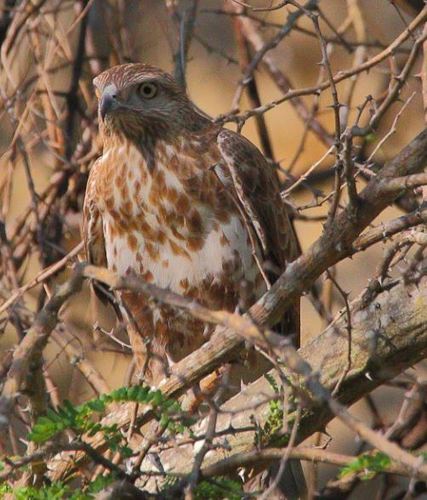
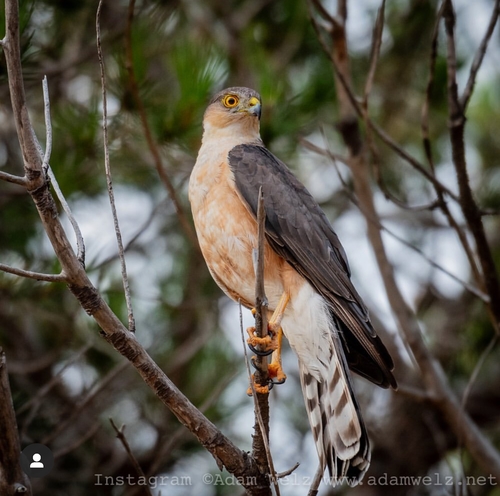
The rufous-breasted sparrowhawk (scientific name Accipiter rufiventris A.Smith, 1830) is a small raptor that reaches around 30 cm in height and 72 cm in wingspan. It gets its common name from its distinctive rufous-coloured underparts, which are visible both when the bird is perching and in flight. The upperparts of its body, including its head, are dark grey slate-brown. It has a black bill, and all age groups have yellow eyes. When in flight, bold bars on both its wings and tail are clearly visible. Juvenile plumage ranges from the adult rufous coloration to a whiter shade, but all juveniles have feathers with dark shaft streaks on their underside. It can be told apart from the similar Ovambo sparrowhawk (Accipiter ovampensis) by its lack of a dark patch behind the eye and a lack of a white eyebrow. In terms of habitat and distribution, the rufous-breasted sparrowhawk has the most restricted range of any accipiter found in southern Africa, though its range has expanded following the introduction of non-native pine species. It occupies montane forest habitats, occurring from the Cape of Good Hope to the Ethiopian highlands, though its local range is quite small and split between separate forest patches. For reproduction, rufous-breasted sparrowhawks perform courtship by flying very high above the nesting area and calling. Mating often happens after the male presents the female with food as a gift. Nests are stick platforms built 6 to 18 meters above the ground. The birds build their nests by snapping off sticks in flight with their talons, or by breaking sticks with their beak. A new nest is usually built each year, and it is often placed very close to the previous year’s nesting site. Two to four eggs are laid in September and October. The eggs are white with red-brown blotches that merge together to form a cap. Incubation is done primarily by the female, while the male retrieves food and delivers it to the female in a nearby tree.