About Accipiter nisus (Linnaeus, 1758)
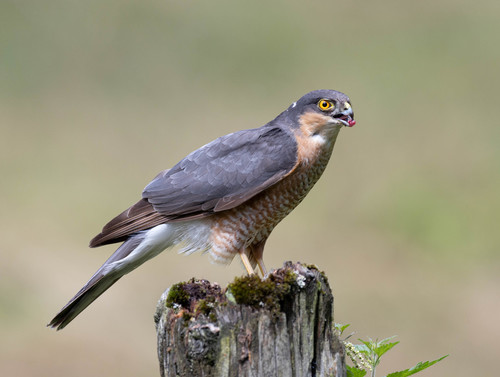
The Eurasian sparrowhawk (Accipiter nisus) is a small bird of prey with short, broad wings and a long tail, both of which are adaptations for maneuvering through trees. Females can be up to 25% larger than males and weigh up to twice as much. This direction of marked size difference is unusual in higher vertebrates, but is typical among birds of prey, and most pronounced in birds of prey that hunt other birds. Adult males measure 29–34 cm (11–13 in) in length, have a wingspan of 59–64 cm (23–25 in), and weigh 110–196 g (3.9–6.9 oz). They have slate-grey upperparts, which sometimes lean toward a bluish tone, with finely red-barred underparts that can look plain orange when viewed from a distance; their irises are orange-yellow or orange-red. Females are much larger, measuring 35–41 cm (14–16 in) long, with a 67–80 cm (26–31 in) wingspan, and a mass of 185–342 g (6.5–12.1 oz). They have dark brown or greyish-brown upperparts, brown-barred underparts, and bright yellow to orange irises. Juveniles have warm brown upperparts with rusty fringes, coarsely barred or spotted brown underparts, and pale yellow eyes; their throats have dark streaks and lack a midline mesial stripe. The Eurasian sparrowhawk's pattern of pale underparts and darker upperparts is an example of countershading, which helps break up the bird's outline. Countershading is seen in birds of prey that hunt birds and other fast-moving animals. The horizontal barring on adult Eurasian sparrowhawks is typical of woodland-dwelling predatory birds, and the adult male's bluish color is also seen in other bird-eating raptors, including the peregrine falcon, the merlin, and other Accipiters. A study using stuffed bird models found that small birds are less likely to approach common cuckoos, which are brood parasites that have barred underparts similar to the Eurasian sparrowhawk. Eurasian reed warblers were found to be more aggressive toward cuckoos that looked less hawk-like, meaning the resemblance to the Eurasian sparrowhawk helps cuckoos access the nests of potential hosts. The Eurasian sparrowhawk has a small bill, which it uses for plucking feathers and pulling prey apart, rather than for killing or cutting. Its long legs and toes are an adaptation for catching and eating birds. The outer toe is fairly long and slender; the inner toe and back toe are relatively short and thick. The middle toe is very long and can be used to grasp objects, and a protuberance on the underside of the toe allows the digit to close without leaving a gap, which improves gripping. Its flight follows a characteristic flap-flap-glide pattern, with the glide creating an undulating shape. This species is similar in size to the Levant sparrowhawk, but larger than the shikra (though their calls differ); the male is only slightly larger than the merlin. Due to size overlap, females can be confused with similarly sized male Eurasian goshawks, but they lack the bulk of that species. Eurasian sparrowhawks are smaller, more slender, have shorter wings, a square-ended tail, and fly with faster wingbeats. A species that is often confused with it in China is the besra, although the subspecies A. n. melaschistos is considerably larger. In Great Britain, Eurasian sparrowhawks that live further north are larger than those from more southern areas; the most reliable body size indicator, wing length, increases by an average of 0.86 mm (0.034 in) for males and 0.75 mm (0.030 in) for females for each degree of latitude further north. The Eurasian sparrowhawk is a widespread species across the temperate and subtropical parts of the Old World. It is either resident or breeds across an estimated global range of 23,600,000 km² (9,100,000 sq mi), and had an estimated total population of 1.5 million birds in 2009. Although global population trends have not been analyzed, population numbers appear to be stable, so the species is classified as Least Concern by the IUCN. The subspecies granti, which has 100 resident pairs on Madeira and 200 resident pairs on the Canary Islands, is threatened by habitat loss, egg-collecting, and illegal hunting, and is listed on Annex I of the European Commission Birds Directive. Along with the common kestrel and common buzzard, it is one of the most common birds of prey in Europe. Populations in Norway and Albania are declining, and Eurasian sparrowhawks are still shot in many parts of Europe. However, this low-level persecution has not had a severe negative effect on populations. In the UK, the population increased by 108% between 1970 and 2005, but saw a 1% decline over the period 1994–2006. In Ireland, it is the most common bird of prey, and even breeds near the city centre of Dublin, where it lives in parks and large gardens. This species is found in most woodland types within its range, and also lives in more open country with scattered trees. Eurasian sparrowhawks prefer to hunt along the edges of wooded areas, but migrating individuals can be seen in any habitat. A Norwegian study found that the increased proportion of medium-aged tree stands created by modern forestry techniques has benefited Accipiter nisus. Unlike its larger relative the Eurasian goshawk, the Eurasian sparrowhawk can be found in gardens and urban areas, and will even breed in city parks if those parks have a sufficient density of tall trees. Eurasian sparrowhawks from colder regions of northern Europe and Asia migrate south for the winter, with some traveling as far as north Africa (and some reaching equatorial east Africa) and India; members of southern populations are resident or only disperse short distances. Juveniles begin their migration earlier than adults, and juvenile females move before juvenile males. Analysis of ringing data collected at Heligoland, Germany found that males migrate further and more often than females; among migrating birds ringed at Kaliningrad, Russia, the average distance traveled before recovery (when the ring is read and the bird's location is reported) was 1,328 km (825 mi) for males and 927 km (576 mi) for females. A study of Eurasian sparrowhawks in southern Scotland found that ringed birds raised on "high grade" territories were recovered in greater proportion than birds from "low grade" territories. This suggests that high grade territories produce young that have better survival rates. The recovery rate also declined as elevation of the breeding ground increased. After the post-fledging period, female birds dispersed greater distances than males. The Eurasian sparrowhawk breeds in well-grown, extensive areas of woodland, often coniferous or mixed woodland, and prefers forest with a structure that is neither too dense nor too open, to provide a range of flight paths. Nests can be located in the fork of a tree, often near the trunk where two or three branches originate, on a horizontal branch in the lower canopy, or near the top of a tall shrub. Conifers are preferred if available. A new nest is built every year, generally close to the previous year's nest, and sometimes an old wood pigeon nest is used as a base (the subspecies A. n. melaschistos frequently uses old jungle crow nests); the male does most of the nest building work. The nest structure is made of loose twigs up to 60 cm (2.0 ft) long, and has an average diameter of 60 cm (24 in). When eggs are laid, a lining of fine twigs or bark chippings is added to the nest. During the breeding season, adult male Eurasian sparrowhawks lose a small amount of weight while feeding their mate before she lays eggs, and also when the young are large and require more food. Adult female weight is highest in May, when eggs are laid, and lowest in August after the breeding cycle is complete. One study suggests that the number of eggs laid and subsequent breeding success depend on the female maintaining a high weight while she is fed by the male. Sexual maturity is reached between 1 and 3 years of age. Most Eurasian sparrowhawks hold the same territory for one breeding season, though some keep the same territory for up to eight years. A change of mate usually triggers a change of territory. Older birds tend to stay in the same territory; failed breeding attempts make moving more likely. Birds that kept the same territory had higher nest success, though success did not increase between years; females that moved experienced more breeding success the year after they changed territory. Eurasian sparrowhawk eggs are pale blue with brown spots; each egg measures 35–46 mm (1.4–1.8 in) by 28–35 mm (1.1–1.4 in), and weighs about 22.5 g (0.79 oz). In a healthy egg, the shell makes up 8% of this weight. Clutches usually contain four or five eggs. Eggs are generally laid in the morning, with an interval of 2–3 days between each egg. If a clutch is lost, up to two additional eggs may be laid, and these replacement eggs are smaller than the original eggs. Altricial, downy chicks hatch after 33 days of incubation. After hatching, the female cares for and feeds the chicks for the first 8–14 days of life, and also continues to do so during bad weather after that point. The male provides food, bringing up to six kills per day in the first week, increasing to eight per day in the third week, and 10 per day in the last week the chicks are in the nest. By this time, the female also begins hunting. By 24–28 days after hatching, young birds start perching on branches near the nest before taking their first flight. They are fed by their parents for a further 28–30 days, staying close to the nest while they grow and practice flying. At this stage, they are extremely vocal, and their calls to their parents can often be heard from a considerable distance away. Young hawks disperse once their parents stop providing food for them. Although male chicks are roughly half the size of female chicks and receive the same amount of food, they mature more quickly and appear ready to leave the nest sooner. In a study conducted in the Forest of Ae, south-west Scotland, 21% of nestlings over two days old died, with causes of death including starvation, wet weather, predation, and desertion by the parents. The parasite Leucocytozoon toddi can be passed from parent to nestling at the nest, possibly because many birds share a small space, which facilitates transmission.