About Acanthoscelides obtectus (Say, 1831)
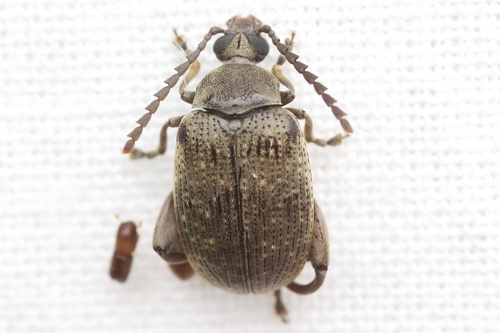
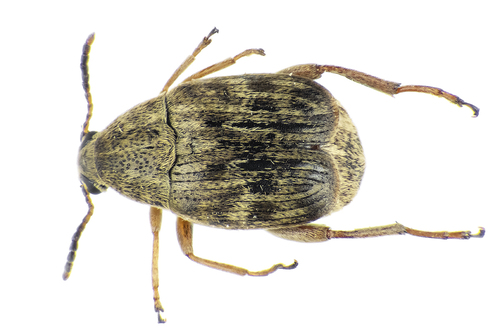
Acanthoscelides obtectus, commonly known as the bean weevil, is a species of small beetle. Adults range in size from 2 to 5 mm, and their body color varies from light to dark brown. Their elytra have longitudinal spots and a red posterior border, and do not cover the end of the abdomen. Legs are yellow-red, antennae are red-brown. The head is bent forward, and lacks the long snout that is characteristic of true weevils. Eggs of this species are milky white. First instar larvae are white with a yellow head; from the second instar onward, larvae are white with a brownish head. Larvae have bristles and three pairs of legs. This species was originally native to northern South America. At the end of the 19th century, grain shipments introduced it to Europe, and it has since spread around the globe. It is now found in Europe, Asia, North and South America, Africa, Australia, and other regions. Bean weevils favor warmer climates. The most favorable temperatures are 27–29 °C for adults, 24–27 °C for larvae, and 22–26 °C for pupae. Temperatures outside this range cause a reduction in the number of eggs laid, and the species is very vulnerable to temperatures below 0 °C. This cold vulnerability limits how far north the species can spread; it is only found as far north as northern Lithuania, and some populations occur in south-west Siberia. Bean weevils develop and feed on leguminous plants. Adult bean weevils hibernate inside the seeds or seed pods of these host plants. Adults emerge from hibernation in April to mate. Female bean weevils lay eggs in groups of 2 to 20, onto seed pods or inside them through chewed holes. A single female can lay up to 200 eggs, but the average fecundity is 40 eggs. Egg development takes 30 to 45 days before a first instar larva hatches. After approximately 3 days, the larva molts into a second instar larva, which then begins to consume the seed. The total larval stage lasts 3 to 3.5 weeks. After the larval stage, the larva pupates inside the seed, and pupation takes 9 to 29 days. A single full generation has a life cycle of 100 to 110 days. If seeds are stored in a warm place, multiple generations can be produced consecutively.