About Acanthoplus discoidalis (Walker, 1869)
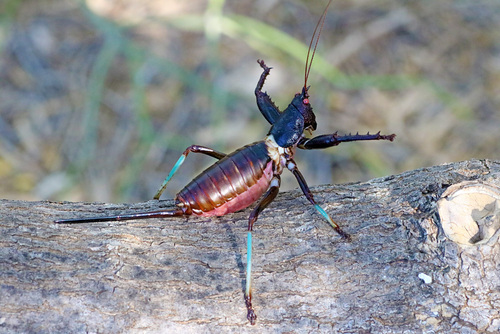
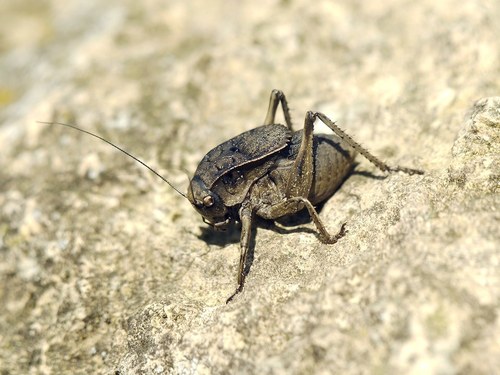
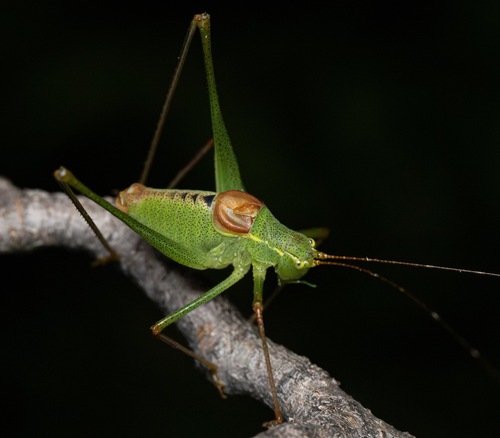
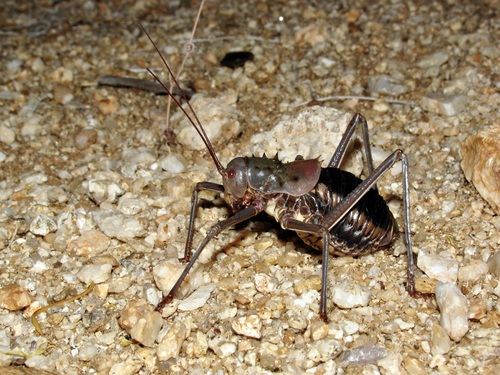
Acanthoplus discoidalis is a wide-bodied, flightless insect that typically reaches a body length of around 5 cm (1.95 inches). Several sharp, conical spines grow on its pronotum. It has powerful main biting jaws called mandibles, which can deliver a painful nip and allow the species to feed on tough materials like herbage and carrion. One of its defensive adaptations against predators is reflex bleeding, also known as autohaemorrhaging: the insect squirts haemolymph from pores in its exoskeleton, reaching a distance of a few centimetres. Courtship and mating in Acanthoplus discoidalis is a relatively slow process. It begins at sunset and is usually finished by sunrise. Male stridulation first attracts females to mate. Males produce a large spermatophore made up of a sperm pouch and an attached spermatophylax, a food portion that acts as a nuptial gift for the female. After mating, a male cannot mate again until it has grown a new spermatophore. A female must mate before laying her first clutch of eggs. After this first mating, she can store sperm, so she may mate and lay eggs again in any order. Because of this sperm storage, it is advantageous for males to mate with virgin females, since a higher proportion of a virgin female’s offspring will belong to that male. Virgin females are lighter than non-virgin females, which allows males to distinguish virgins during copulation. As a result, males complete more matings with virgins than with non-virgins, and they transfer their spermatophore more quickly when mating with virgins.