About Acanthomintha ilicifolia A.Gray
Scientific name: Acanthomintha ilicifolia A.Gray, commonly called San Diego thornmint
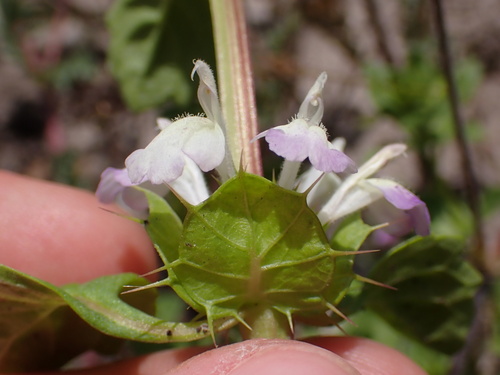
Description: Acanthomintha ilicifolia is a small annual herb that reaches a maximum height of approximately 15 centimeters (6 inches). It bears rounded to oval, serrated leaves that grow up to 1.5 cm (5⁄8 inch) long. The inflorescence forms a cluster of flowers, accompanied by oval bracts nearly 1 centimeter long, which are edged with long spines. Each flower is about 1 centimeter wide, white and often tinted purple to pink, with a hooded upper lip and a slightly longer lower lip. This species can be distinguished from other members of the Acanthomintha genus by its hairless anthers and style. It germinates in late winter, flowers between April and May, and produces seeds between June and July. A single flower can produce up to 4 seeds, while an individual plant produces between 70 and 200 seeds. This species forms a persistent seed bank. Germination rate correlates with seed age, with higher germination rates observed in older seeds.
Distribution and habitat: This species is generally restricted to San Diego County, California (United States), and certain areas of Baja California, Mexico. Most of its global distribution falls within the United States: as of 2009, over 80 historical occurrences were recorded in the U.S., compared to just 13 occurrences in Mexico. It grows in chaparral, coastal sage scrub, and grassland habitats, preferring gabbro and calcareous clay soils on gentle slopes with angles between 15 and 20 degrees.
Threats: The destruction or modification of habitat is the most major threat to this species. Older threats that have declined in severity over time include mining operations that alter soil conditions. More current threats include habitat damage from fire and invasive plant species. Common invasive species occurring in its habitat are Avena spp., Brachypodium distachyon, Brassica nigra, Centaurea melitensis, Cynara cardunculus, and Foeniculum vulgare. Other forms of habitat modification affecting the species include broad urban development, livestock grazing, waste dumping, and off-road vehicle activity.
Ecology: Relatively little is documented about the pollination of this species, but it is thought to be pollinated by bees and checkered beetles. Two other species in the Acanthomintha genus—San Mateo thornmint (Acanthomintha duttonii) and heartleaf thornmint (A. obovata ssp. cordata)—are confirmed self-pollinators, and there is also evidence of self-pollination in San Diego thornmint.