About Acanthocinus aedilis (Linnaeus, 1758)
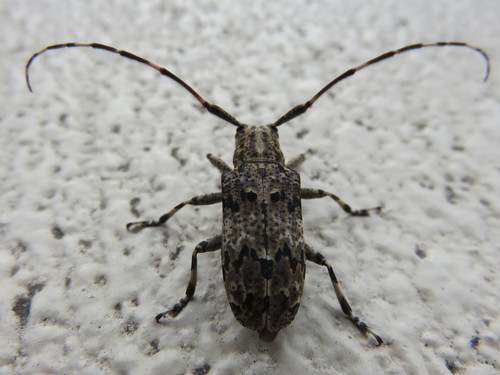
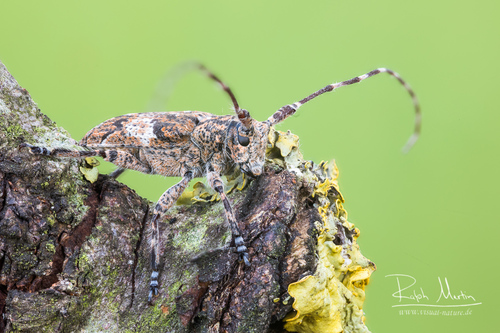
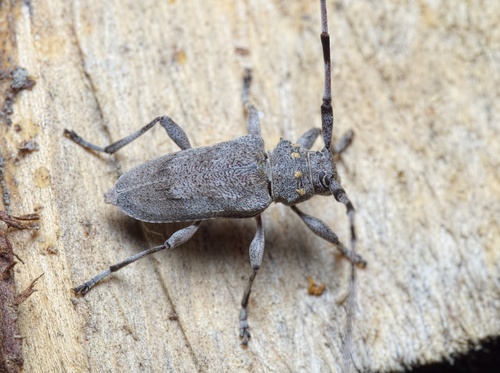
The timberman beetle, with the scientific name Acanthocinus aedilis, is a species of woodboring beetle in the longhorn beetle family. This species inhabits woodlands and has a large distribution across Europe, Russia, and Central Asia. Its range extends north into Siberia, so it is also commonly called the Siberian Timberman. It goes by the name Sarvijaakko in Finnish, Timmerboktor in Dutch, and Större Timmerman in Swedish. Although a small number of sources mention reported sightings of this species in Central America, there were no confirmed reports as of May 2020, when this description was edited. The species is also not listed as invasive in North America. Adult body length for this species ranges from 12 to 20mm. Males have antennae up to three times their body length, while females have antennae up to one and a half times their body length. The total lifespan of the timberman beetle can reach up to 3 years, which includes a 1 to 2 year larval stage. Both adult and larval stages of this species can survive freezing temperatures below -37 °C. Adults are active between March and June, and are diurnal during this active period. Adults overwinter in pupal chambers located in leaf litter or under tree bark. In Continental Europe, this species has become a serious pest of commercially grown timber. Larvae feed under the bark of host trees, which weakens the trees. After infesting already weakened trees and excavating galleries under their bark, the trees eventually die. When the species develops within wood debris in natural forests, it provides a benefit by supporting nutrient cycling in forest ecosystems. However, it can also help spread pathogenic fungi throughout woodlands. Key food sources for this beetle species are Scots pine (Pinus sylvestris L.) and Norway Spruce (Picea abies). A distribution map for this species within the United Kingdom is available courtesy of the National Biodiversity Network. In 2018, Wildlife Trust BCN categorized this species as Nationally Scarce category B within Great Britain.