About Acanthocereus tetragonus (L.) Hummelinck
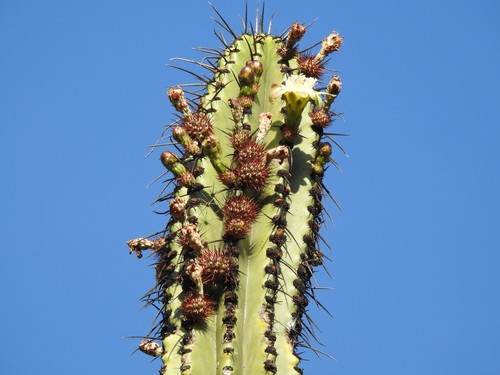
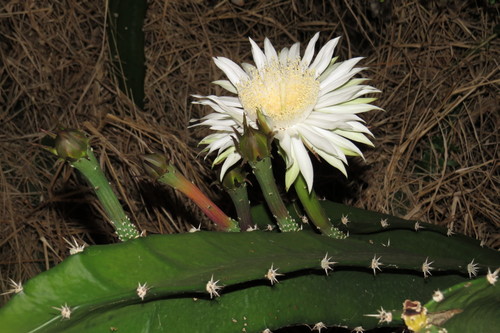
Acanthocereus tetragonus is a tall, columnar cactus that grows to a height of 2–7 m (6.6–23.0 ft). Its dark green stems have three to five angles and measure 6–8 cm (2.4–3.1 in) in diameter. The grey areoles are spaced 2–3 cm (0.79–1.18 in) apart. Central areoles bear one to two spines that can reach up to 4 cm (1.6 in) long, while radial areoles have six to eight spines up to 2.5 cm (0.98 in) long. The flowers are 14–20 cm (5.5–7.9 in) in diameter, with an 8–15 cm (3.1–5.9 in) long floral tube. Outer tepals are greenish-white, inner tepals are pure white, and pistils are creamy white; some descriptions note flowers have a deep red, orange, or red-orange center. Flowers are showy, open only from midnight until dawn (closing during the day), bloom a few times per year in multi-week blooming events, and attract hummingbird moths (Hemaris spp.). The shiny red fruits are around 5 cm (2.0 in) long. This is a highly spiny, often large, thicket-forming cactus that may grow taller than 10 feet; the thickets it forms in coastal hammocks can be spiny and impenetrable. It is native to hot, dry, sandy coastal habitats, coastal hammocks, and coastal thickets of central and southern Florida, the Florida Keys, and regions south into the Caribbean. Young stems of this species (also called barbed-wire cactus) can be eaten raw or cooked as a vegetable; the edible fruits are sweet. It is sometimes cultivated as an outdoor ornamental plant, and may be planted to form a living fence. A miniature cultivar, the fairy castle cactus, is commonly grown as a houseplant, valued for its small size and interesting shape.