About Acanthagrion quadratum Selys, 1876
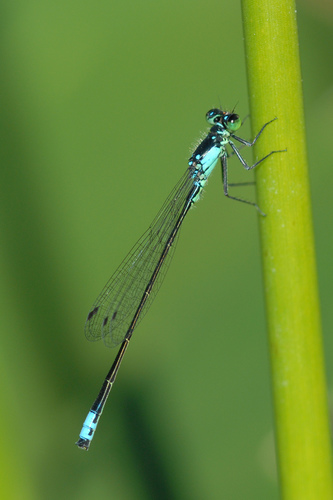
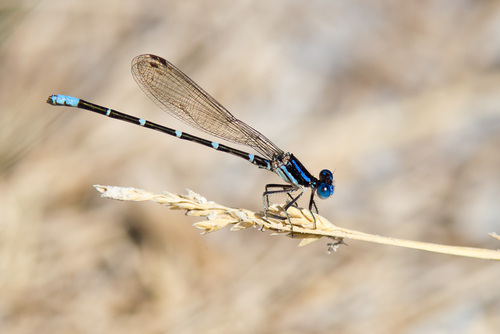
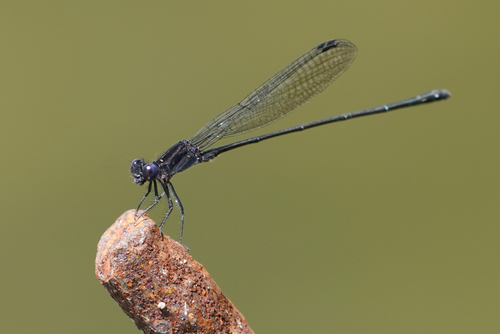
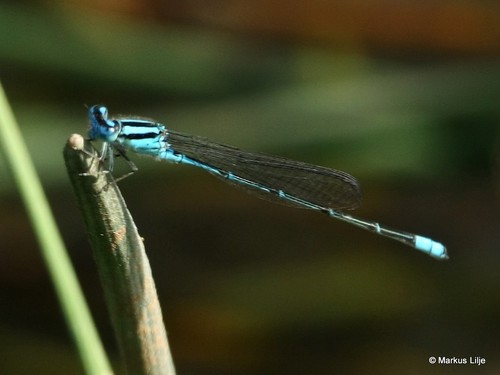
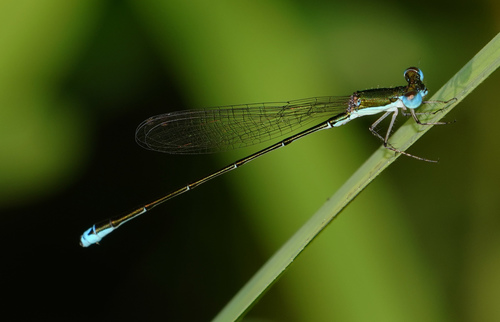
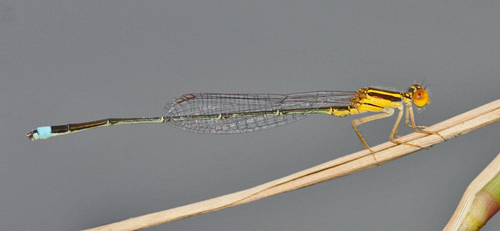
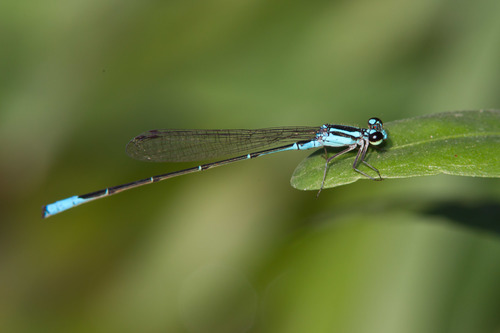
This damselfly species is scientifically named Acanthagrion quadratum Selys, 1876. For adult identification: adult males have a distinctive abdominal tip. Their eyes are mostly black, with green tones on the lower portion, and they have large blue post-ocular spots. The male thorax is blue, with medium blue and black humeral stripes and a thin white line along the sides. The male abdomen is black, with blue markings on the sides of segments 1 and 2, the end of segment 7, and all of segments 8 and 9. Females share a similar color pattern with males, but have lighter colored eyes. The female thorax is a paler shade of blue, and the female abdomen has markings on its sides and tip; usually, the base of segment 8 is blue. Segment 9 is blue with black markings on each side of its base, and segment 10 is entirely blue. Abdominal tip coloration is quite variable across populations, and individuals from more southerly distributions have less blue color at this tip. Larvae of this species can be distinguished from other larvae in the same genus by three key features: they have 3 premental setae, 4 setae on the lip palpus, and a caudal lamella that is 8 to 10 times longer than it is wide at its broadest point. This species occupies vegetated ponds, slow-flowing creeks, open marshes, and marshy areas beneath dense vegetation cover. Its distribution ranges from the southern United States down to Costa Rica. Within Mexico, it has been recorded in 14 states: Campeche, Chiapas, Coahuila, Hidalgo, Nuevo León, Oaxaca, Puebla, Querétaro, Quintana Roo, San Luis Potosí, Tabasco, Tamaulipas, Veracruz, and Yucatán. Acanthagrion quadratum is an abundant species.