About Acalypha wilkesiana Müll.Arg.
Scientific name: Acalypha wilkesiana Müll.Arg.
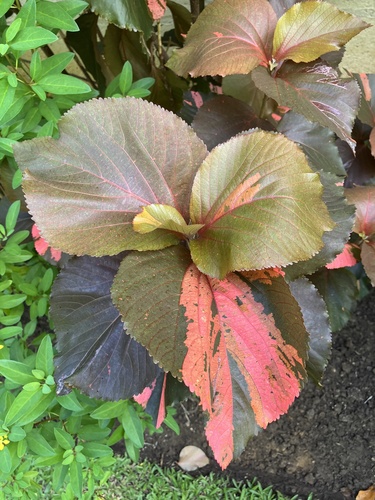
Introduction Acalypha wilkesiana, with common names copperleaf, Jacob's coat and Flamengueira, is an evergreen shrub that reaches 3 meters (9.8 ft) in height and 2 meters (6 ft 7 in) in width. It has a densely packed crown, an erect stem, and numerous branches. Both branches and leaves are covered in fine hairs. Its leaves are large and broad, with toothed edges, and can be either flat or crinkled; they measure 10–20 centimeters (3.9–7.9 in) long and up to 15 centimeters (5.9 in) wide. The leaves are coppery green marked with red splashes, giving a mottled appearance. This species produces separate male and female flowers on the same individual: male flowers grow in long, downward-hanging spikes, while female flowers form short spikes that are often hard to spot because they are hidden among leaves. Flower stalks are 10–20 cm long.
Distribution and Habitat A. wilkesiana is a tropical and subtropical plant that grows naturally in Vanuatu and occurs across the Pacific Islands. It prefers light, well-drained soil and grows best in a protected, shady position. It can be damaged by both drought and frost, requires a minimum temperature above 10 °C (50 °F), and is best suited to USDA hardiness zones 10–12. Documented locations where this species occurs include: Dominica, Zimbabwe, Botswana, South Africa, Zambia, Asia, Australia, The Bahamas, Bermuda, Brazil, Fiji, Hawaii, Indochina, Indonesia, Kenya, Malaysia, Nigeria, Norfolk Island, Pacific Islands, Pakistan, Papua New Guinea, Polynesia, Tanzania, Thailand, Tonga, Uganda, United States of America, Vanuatu, and Vietnam.
Cultivation In South Florida and tropical America, copperleaf is a popular outdoor plant that provides ornamental color year-round. It is used in mixed hedges, shrub borders, and as a standalone specimen shrub. In regions outside its preferred hardiness range, copperleaf is grown as an annual, where its striking foliage provides ornamental interest from late summer until the first frost. Copperleaf can also be grown indoors as a container plant, but requires a warm, humid, bright environment to thrive.
Medicinal Use and Research Ointment made from Acalypha wilkesiana is used to treat fungal skin diseases. A 2003 non-comparative study by Oyelami et al. evaluated the safety and efficacy of this ointment on 32 Nigerian patients with mycologically and clinically confirmed mycoses. The ointment successfully controlled mycoses in 73.3% of affected patients, and achieved a 100% cure rate for Pityriasis versicolor, Tinea pedia, and Candida intertrigo. The study concluded that Acalypha wilkesiana ointment is effective for treating superficial mycoses. In 2005, Akinyemi et al. evaluated crude extracts from six medicinal plants (Phylantus discoideus, Ageratum conyzoides, Terminalia avicennioides, Bridella ferruginea, Acalypha wilkesiana, and Ocimum gratissimum) for activity against Methicillin-resistant Staphylococcus aureus (MRSA). Both water and ethanolic extracts of Acalypha wilkesiana showed activity against tested MRSA strains isolated from patients. Across all tested active plants, minimum bactericidal concentration (MBC) ranged from 30.4–37.0 μg/ml, and minimum inhibition concentration (MIC) ranged from 18.2–24.0 μg/ml. This study provided scientific support for the use of Acalypha wilkesiana, T. avicennioides, O. gratissimum, and P. discoidens to treat MRSA-related diseases.