About Acalypha virginica L.
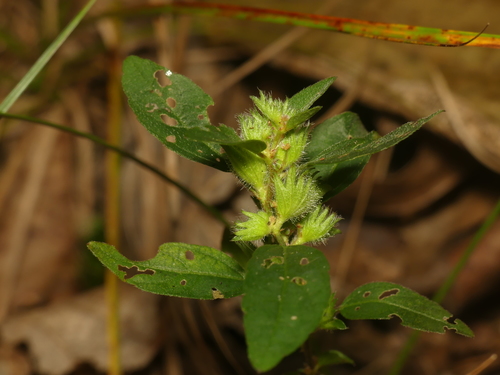
Acalypha virginica, commonly known as Virginia threeseed mercury or Virginia copperleaf, is a species of plant in the spurge family Euphorbiaceae. It is native to the eastern United States. It occurs in a range of natural habitats, most commonly open woodlands and riverbanks. It is a somewhat weedy species that grows well following ecological disturbance, and can also be found in degraded habitats like agricultural fields. It is an erect herbaceous annual that grows up to 50 centimeters (20 inches) tall. This species is monoecious, and produces small greenish axillary flowers that lack petals. It blooms from summer through fall. It resembles Acalypha gracilens, which shares most of its geographic range. Acalypha virginica can be told apart by its pistillate bracts, which are hirsute and lack glands; in contrast, Acalypha gracilens has pistillate bracts that are sparsely pubescent and bear red glands. Globally, Acalypha virginica is classified as secure, and it is common across most of its range, occurring in a wide variety of habitats. However, it is uncommon near the edges of its range: it is listed as a special concern species in Connecticut, and it is thought to be extirpated from Maine, where the only documented record is a specimen collected from Parsonsfield in 1902.