About Acalypha rhomboidea Raf.
Scientific name: Acalypha rhomboidea Raf.
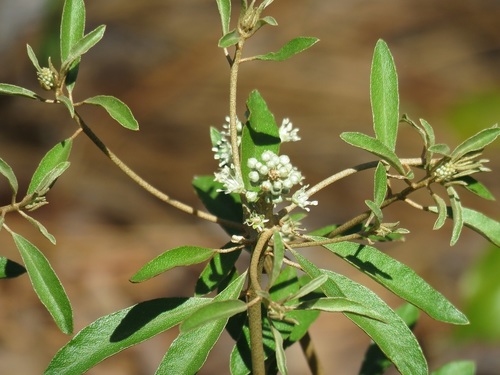
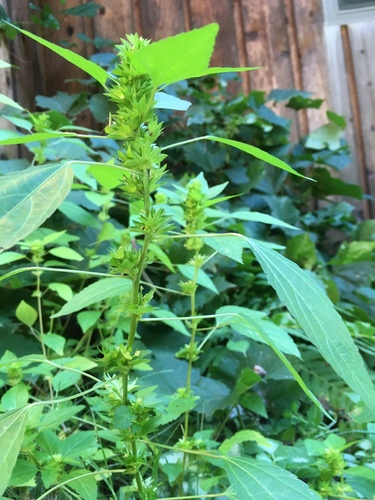
Description: Common three-seeded mercury is an annual herbaceous plant. It grows from a taproot, reaching 15–60 cm (1⁄2–2 ft) in height, and is usually unbranched. The central stem may be either covered in fine white hairs or hairless. Its alternate leaves are lanceolate to lanceolate-rhombic with acute tips, borne on slightly hairy petioles around 4 cm (1+1⁄2 in) long. Leaves have bluntly serrated margins and pinnate venation; they are deep green and somewhat shiny on the upper surface, light green and mostly hairless on the lower surface, and can grow up to 7 cm (2+3⁄4 in) long and 4 cm (1+1⁄2 in) wide. Leaves tend to cluster near the top of the stem(s). A conspicuous, slightly ciliate bract with 5–9 lobes grows at the junction of the leaf petiole and stem, and wraps around the inflorescence, which is a green cyathium. The cyathium holds minute staminate and pistillate flowers that lack petals. Male flowers form capitate clusters at the end of the peduncle; they have four tiny golden green, upward-curving sepals (acute to blunt in shape) and many stamens. Female flowers have minute green sepals, a hairy tri-locular ovary, and three fringed styles. One seed develops per locule. Mature pods are tan-colored, 1.6–1.8 mm (1⁄16–5⁄64 in) long, and deeply lobed. The flowers have no floral scent. Unlike most other members of the Euphorbiaceae family, which typically have milky sap, this species has clear sap.
Acalypha rhomboidea is very similar in appearance to Acalypha virginica; the two can be distinguished by the number of bract lobes: A. virginica has 9–15 lobes, while A. rhomboidea has only 5–9. A. rhomboidea also resembles young redroot pigweed (Amaranthus retroflexus L.), but can be told apart by its flower clusters, bracts, and occasionally bronze-green leaves.
Distribution and habitat: Acalypha rhomboidea is native to Eastern Canada, and the Northeastern, Southeastern, and Central United States. It often grows in fertile loam, but will also tolerate gravelly or clay soil. It prefers disturbed habitats. It can be found growing in moist to mesic black soil prairie, openings or lightly shaded areas of upland and floodplain forest, thickets, seeps, riverbanks and lake shores, limestone glades and bluffs, fields, fence rows, roadside and railroad right-of-ways, vacant lots, and waste areas.
Ecology: The blooming period for this plant runs roughly from mid-summer until fall frost, with the flowering period lasting one month or longer. Its seeds are a favored food source for birds including the mourning dove and greater prairie chicken. Deer browse on Acalypha species including this plant. In crop fields where group 2 herbicides have been used repeatedly, this plant can become a serious, damaging weed.