About Acalypha gracilens A.Gray
Scientific name: Acalypha gracilens A.Gray
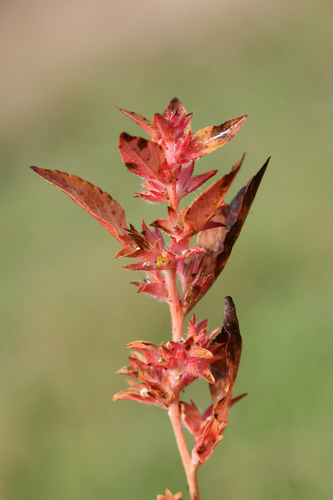
Description: This is an annual monoecious plant, meaning it bears both pistillate (female) and staminate (male) flowers on the same individual. It grows erect up to 0.8 m tall, with freely branched stems that arise from a taproot. Stems are densely pubescent, covered in short, incurved or appressed ascending trichomes.
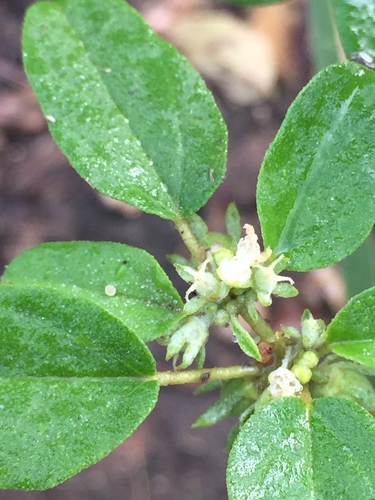
Leaves are alternate, petiolate, and elliptic to elliptic-lanceolate, measuring 2–6 cm long and 0.5–2 cm wide. The leaf base is cuneate to rounded, and the leaf apex is obtuse. Leaf margins are crenate to crenate-serrate. Two prominent lateral veins originate from the leaf base and run parallel to the midrib. Both leaf surfaces are pubescent, and may become more or less glabrate with age. Petioles of primary leaves are 0.4–1.5 cm long.
Spikes may be axillary, terminal, or both. Bracts are leaf-like; no petals are present on any flowers. Axillary spikes typically hold 1–5 pistillate flowers near their base, with a continuous spike of staminate flowers extending above the interrupted pistillate portion. Pistillate bracts are often stipitate-glandular, with 5–13 triangular teeth. Pistillate flowers have 3–5 sepals and a 3-locular ovary. Staminate flowers have 4 sepals and 8–16 stamens. Mature capsules are broader than they are long. Seeds are ovoid, reddish to black, and 1.2–1.8 mm long.
Phenology: Across most of its range, it flowers from spring through fall, from June until late frost. In southern Florida, it flowers year-round.
Distribution: It is found across the southeastern U.S. coastal plain, piedmont, eastern Midwest, and New England. It is common throughout the coastal plain and Piedmont region, and infrequent in mountains.
Habitat: In the southeastern U.S. coastal plain, it is a common species found in frequently burned sandhills (Entisols), pine flatwoods (Spodosols), upland pine communities (Ultisols), and floodplain forests (Alphisols). It thrives in frequently burned pine communities, occurring in both intact native communities and highly disturbed areas. It grows across a broad range of well-drained soils, from deep sand to loams, and tolerates a wide range of light conditions from full sun to shaded sites at clearing margins. It is an indicator species for the Clayhill Longleaf Woodlands community type (as described by Carr et al., 2010). It increases in abundance as a short-term response to single mechanical soil disturbance, and also increases in the long term after repeated soil disturbance ceases. Common associated species include Liatris gracilis, Liatris tenuifolia, Polygonella gracilis, Didodia teres, Chrysopis lanuginosa, Rubus cuneifolis, Hypericum gentianoides, Trichostema dichotomum, and Eupatorium compositifolium.
Fire ecology: Populations of Acalypha gracilens persist through repeated annual and biennial burns.