About Acalymma vittatum (Fabricius, 1775)
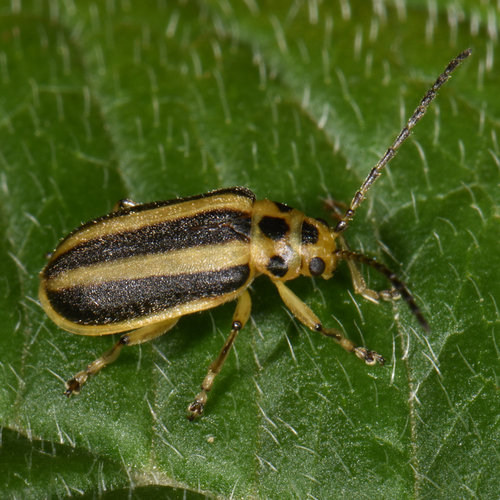
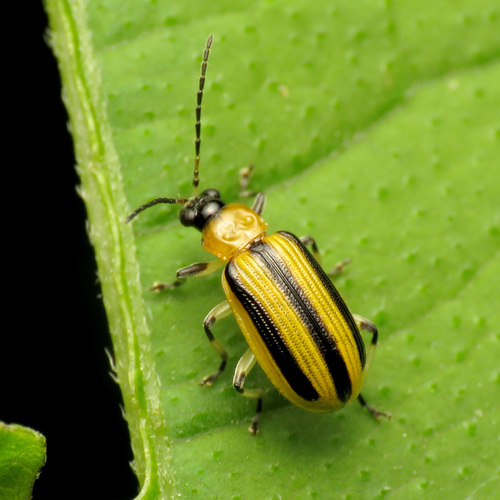
Acalymma vittatum, commonly known as the striped cucumber beetle, has distinct physical characteristics for its adult stage. Adult striped cucumber beetles have distinctive yellow elytra marked with black stripes, most often three black stripes that run the full length of the elytra. Their heads are either black or brown, their prothorax is yellow, and their abdomen is black beneath the striped elytra.
Adults of this species are frequently confused with adult western corn rootworms, which share similar traits: yellow elytra with three black stripes, a yellow prothorax, and a brown or black head. However, the two species can be reliably differentiated by two key features. Western corn rootworm adults are larger than adult striped cucumber beetles, averaging around 6.3 mm in length compared to the striped cucumber beetle's average adult length of approximately 5.25 mm. Additionally, the black stripes on western corn rootworm elytra do not extend fully to the tip of the elytra, and fade before reaching the end. This means adult striped cucumber beetles are distinguished by their average 1 mm shorter length and black stripes that reach all the way to the end of the elytra.
The pupa of the striped cucumber beetle measures around 10 mm in length, has a white abdomen, and tapers in width from the center of the abdomen to the end, forming a rounded tip at the abdomen's end.
This species is native to North America, with a geographic range extending from Mexico to southern Canada. It occurs in large populations in the eastern United States, and is less widespread in western parts of North America west of the Rocky Mountains. In this western region, the western striped cucumber beetle, Acalymma trivittatum, is the dominant species instead.