About Acaena novae-zelandiae Kirk
Scientific name: Acaena novae-zelandiae Kirk
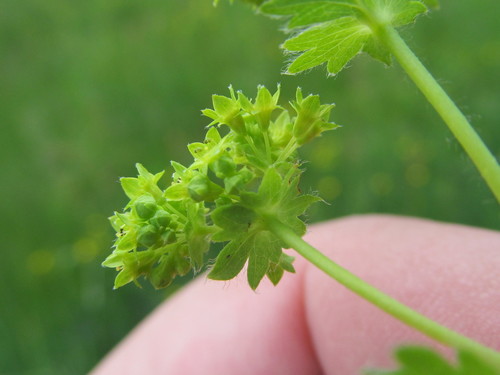
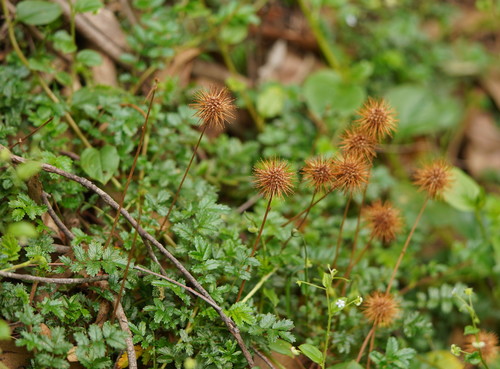
Description: Acaena novae-zelandiae is a small herbaceous perennial plant. It is stoloniferous, with prostrate stems measuring 1.5–2 mm in diameter. Damage to its stolons stimulates the production of new shoots. It bears imparipinnate leaves approximately 2–11 cm long, with 9–15 toothed, oblong leaflets. The adaxial (upper) leaf surface is dark green and shiny, while the abaxial (lower) surface is hairy and glaucous green. The leaf rachis is often red. The 10–15 cm long scape bears a globular, terminal inflorescence 20–25 mm in diameter, containing 70–100 flowers. The flowers have no petals, and their colour ranges from green to white or purple. They are wind-pollinated. Each flower produces a single achene, which bears four approximately 10 mm long spines tipped with barbs. These barbs help dispersal by allowing the fruit to attach to wool, feathers, and various clothing materials. When the fruit are ripe, their spines are red; the spines turn brown as they age.
Distribution and habitat: Commonly called red bidibid, this species is native to New Zealand, Australia, and New Guinea. It has become naturalised in California, Great Britain, and Ireland. It is classified as invasive in Great Britain, where it has established populations in habitats including the dunes of Lindisfarne. It grows across a very broad range of habitats, including woodlands, shrublands, and grasslands, ranging from coastal areas to alpine areas. It prefers freely draining soils such as silty and sandy loams, and typically grows on sites that receive high amounts of sunlight. It also establishes very easily on disturbed sites such as roadsides.
Uses: Acaena novae-zelandiae can be used as ground cover in gardens, or as a lawn substitute. Its spread can be controlled by limiting disturbance to its stolons (to reduce vegetative propagation), and by mowing flowers before burrs form. It has also been suggested that dried "tiny tips" of young, succulent leaves of this plant may be brewed to make tea.