About Acaena anserinifolia (J.R.Forst. & G.Forst.) Druce
Scientific name: Acaena anserinifolia (J.R.Forst. & G.Forst.) Druce
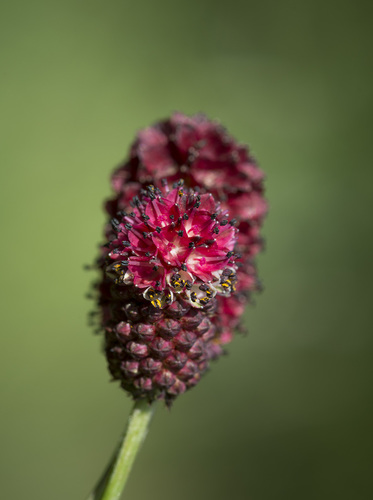
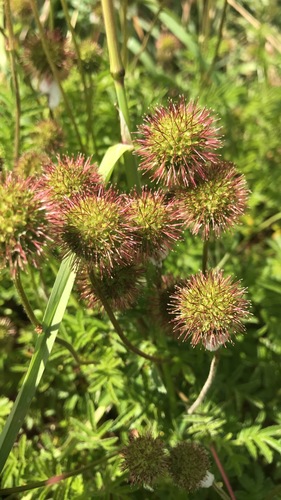
Description: Bidibidi (also called piripiri) is a small plant with deeply divaricated opposite leaflets and long stems that terminate in a globular capitulum. Its flowers can be pink, red, or white. It can be distinguished from the related species Acaena novae-zelandiae by two key features: the distinctive tuft of brush-like hairs at the apex of leaf teeth, and the silvery color of its leaf undersides.
Distribution and habitat: Acaena anserinifolia is native to New Zealand's North Island, South Island, Stewart Island, and Chatham Islands. It has been introduced to the Antipodean Islands, Great Britain, and Ireland, and is naturalised on the Auckland Islands and Campbell Island. This species grows from lowland to subalpine areas, and along forest edges; it is sometimes hydrorphytic.
Ecology: The ability of this species' seeds to attach to clothing likely evolved for seed dispersal via attachment to the feathers of New Zealand flightless birds, including kiwi, weka, and moa.
Traditional Māori cultural uses: In traditional Māori rongoā medicinal practice, boiled piripiri leaves are used to make either a healing tonic, or a topical lotion applied to the skin. Smoke from burning piripiri was traditionally used as a remedy for people poisoned by tutu.
European and modern uses and impacts: Early European settlers in New Zealand boiled the plant's leaves to make tea when imported tea leaves were scarce. For New Zealand livestock farmers, the plant's seeds are a problematic issue: their ability to stick to animal fur can injure livestock, or cling to wool and make wool processing difficult. Acaena anserinifolia is cultivated as a garden plant in Europe and North America.