About Acacia tetragonophylla F.Muell.
Scientific name: Acacia tetragonophylla F.Muell. Common name: Curara
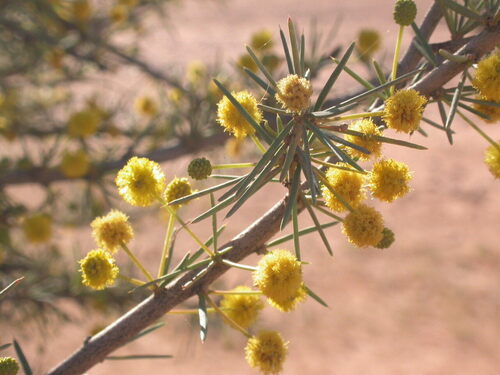
Description: Curara grows as a tall shrub or small tree, reaching 1.5 to 5 m (4 ft 11 in to 16 ft 5 in) in height. It has an intricate, often straggly growth habit, with glabrous branchlets. Like most Acacia species, it has phyllodes rather than true leaves. These phyllodes are slender and needle-like, 1 to 5 cm (0.39 to 1.97 in) long and 1 mm (0.039 in) wide. They are soft and pliable when young, becoming hard, rigid, and very sharp at maturity. The glabrous phyllodes grow in groups of 2 to 6 on small, knotty lateral branchlets, or singly on new shoots. They have a slender linear shape ending in a sharp point, with a mostly pentagonal to compressed cross-section, and five to seven prominent nerves.
In Western Australia, this species blooms between May and October, producing yellow flowers arranged in spherical clusters. The seed pods are papery, growing up to 8 cm long and approximately 5 mm wide.
Distribution: It grows on floodplains and along watercourses in arid and semi-arid regions across Western Australia, South Australia, and the southern Northern Territory, extending east to near Charleville, Queensland and Brewarrina, New South Wales. It is known to grow in a wide range of habitats and soil types. In Western Australia, it occurs in the Pilbara, Gascoyne, Mid West, Wheatbelt, and Goldfields-Esperance regions.
Uses: Central Australian Aboriginal people collect its seeds to make seedcakes. Its Pitjantjajara name is Wakalpuka. Acacia tetragonophylla is used to treat warts: the apices of its phyllodes are inserted into the wart, with the rest of the phyllode broken off to leave the tip embedded in the tissue. After four to five days, the wart shrivelled and can be easily removed.