About Acacia suaveolens (Sm.) Willd.
Scientific name: Acacia suaveolens (Sm.) Willd.
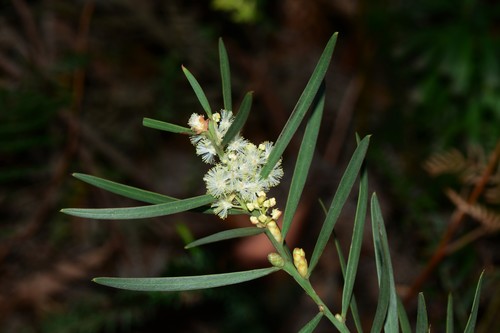
Introduction Acacia suaveolens, commonly called sweet wattle, is a shrub species endemic to Australia. It grows between 0.3 and 3.5 metres high. It has smooth purplish-brown or light green bark, and straight or slightly curving blue-green phyllodes. In its native range, pale yellow to near-white globular flower heads generally appear between April and September. Flowering is followed by the development of flattened, bluish oblong seed pods, which reach 2 to 5 cm long and 8 to 19 mm wide.
This species was first formally described by English botanist James Edward Smith in 1791, published in Transactions of the Linnean Society of London. Smith's description was based on a cultivated plant growing at Syon House, which had been grown by Thomas Hoy from seed collected originally in New South Wales. Carl Ludwig Willdenow transferred the species to the genus Acacia in 1806.
In its native range, Acacia suaveolens naturally occurs on sandy soils in heathland and dry sclerophyll forest in South Australia, Victoria, Tasmania, New South Wales and Queensland.
Cultivation This species produces winter colour in gardens, and may be used as a low screen plant.