About Acacia spirorbis Labill.
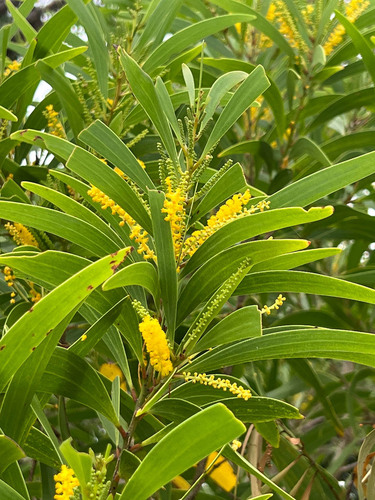
Acacia spirorbis Labill. is a tree that typically grows to a maximum height of 12 metres (39 feet), with slender, hairless branchlets. Like most Acacia species, it has phyllodes instead of true leaves. These dark green, hairless phyllodes are narrowly elliptic in shape, and curve to a sickle form. They measure 9 to 17 cm (3.5 to 6.7 in) in length and 6 to 16 mm (0.24 to 0.63 in) in width, with two main longitudinal veins that are more prominent than all other veins. When blooming, the species produces simple inflorescences that grow in pairs in the leaf axils. The cylindrical flower spikes are 3 to 8 cm (1.2 to 3.1 in) long, and hold creamy-coloured flowers arranged in interrupted bands. After flowering, it forms flat, spirally coiled, hairless seed pods that are 3.5 to 5 mm (0.14 to 0.20 in) wide and covered in a fine white powder. The seeds inside these pods are arranged either longitudinally or slightly obliquely. The shiny dark brown seeds are oblong in shape, with a bright yellow aril that is folded multiple times below the seed. This species is endemic to coastal Queensland, Australia, where its range extends from Townsville in the north down to around MacKay in the south, including numerous islands off the coast. There is also a smaller isolated population on Rat Island, further south near Rockhampton. It usually grows along the margins of rainforest communities, or as a component of Eucalyptus woodlands in drier areas. It is also native to Vanuatu and New Caledonia.