About Acacia rubida A.Cunn.
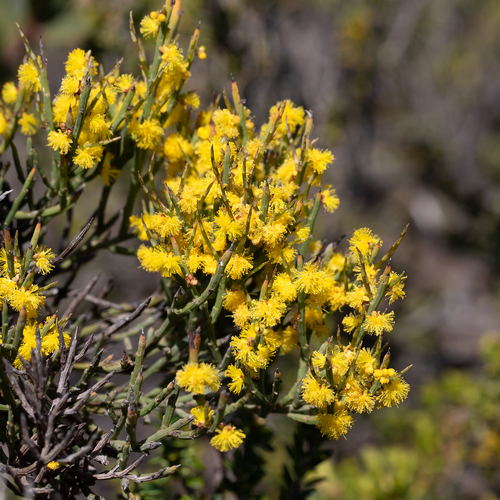
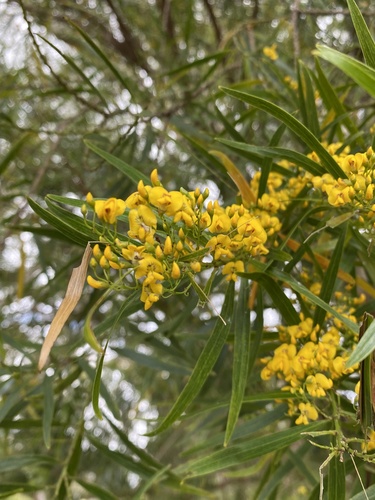
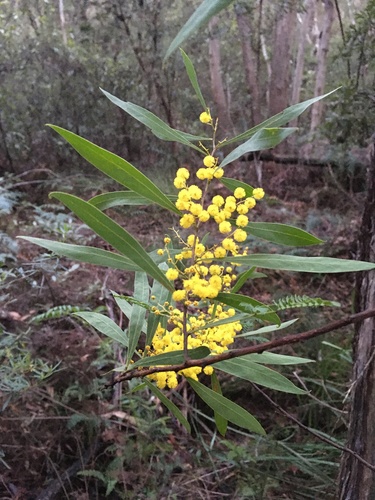
Acacia rubida A.Cunn. is a shrub or tree with an erect to bushy growth habit, typically reaching 2 to 10 meters (6 ft 7 in to 32 ft 10 in) in height. It has lightly fissured brown bark, and leathery phyllodes that range in shape from narrowly elliptic to oblanceolate, and in color from reddish to grey-green. The phyllodes measure 5 to 20 cm (2.0 to 7.9 in) in length and 8 to 25 mm (0.31 to 0.98 in) in width. Its juvenile foliage is pinnate, and may remain present on mature plants. Flowering occurs between July and November, producing inflorescences bearing pale to bright yellow flowers. Simple inflorescences form in axillary racemes in groups of 5 to 29, with a raceme axis measuring 1 to 10 cm (0.39 to 3.94 in) long. The spherical flower heads are 5 to 7 mm (0.20 to 0.28 in) in diameter, and each contains 9 to 15 pale to bright yellow flowers. After flowering, straight, flat, glabrous seed pods develop that are firmly papery to thinly leathery. The seed pods are 4 to 12 cm (1.6 to 4.7 in) long, 6 to 9 mm (0.24 to 0.35 in) wide, and are often covered with a white powdery coating. This species is distributed in southwestern Queensland, western New South Wales, and Victoria, growing on the tablelands of the Great Dividing Range. Most of the population occurs between the Black Range in northeastern Victoria (the southern end of the range) and near Stanthorpe in southeastern Queensland (the northern end of the range). It is commonly a member of open woodland or dry sclerophyll forest communities, growing on rocky hilltops and slopes in rocky soils, as well as in alluvial soils along rivers and creeks. Acacia rubida is sold commercially as tubestock or seed. It is regarded as a good pioneer species: it is fast-growing, hardy, cold tolerant, and acts as a nitrogen-fixing plant. It can grow in nutrient-poor, shallow, skeletal, high-altitude soils, and plays a valuable role in catchment protection within its native range. It prefers a sunny position, requires minimal maintenance, is drought tolerant, and can withstand temporary inundation.