About Acacia rigens A.Cunn. ex G.Don
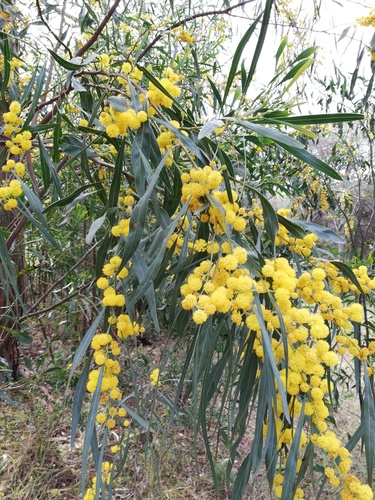
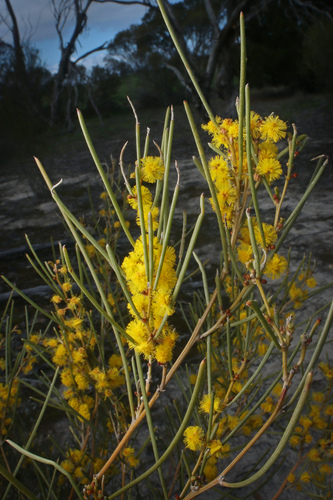
Description: Plants of this species typically grow to a height of 1 to 6 m (3 ft 3 in to 19 ft 8 in). They have rigid, terete phyllodes that measure 3 to 13 cm (1.2 to 5.1 in) in length. Bright yellow flowerheads grow in groups of up to four in the axils of the phyllodes. The simple inflorescences bear resinous, spherical flower-heads with a diameter of 4 to 7 mm (0.16 to 0.28 in). Each flower-head contains 20 to 30 bright yellow, 5-merous flowers. In the species' native range, flowering occurs between July and December. After flowering, it produces curled, twisted or coiled seed pods that are 4 to 10 cm (1.6 to 3.9 in) long and 2 to 3 mm (0.079 to 0.118 in) wide. Distribution: This species grows on red earth, sandy or shaly soils in mallee and woodland habitats, and occurs across southern Western Australia, South Australia, Victoria, New South Wales and Queensland. Cultivation: It is a fast-growing species that tolerates both frost and drought. After establishment, it rarely needs additional watering. It adapts well to most soil types and grows best in full sun or light shade. The larvae of the double-spotted lineblue butterfly feed on this species.