About Acacia retinodes Schltdl.
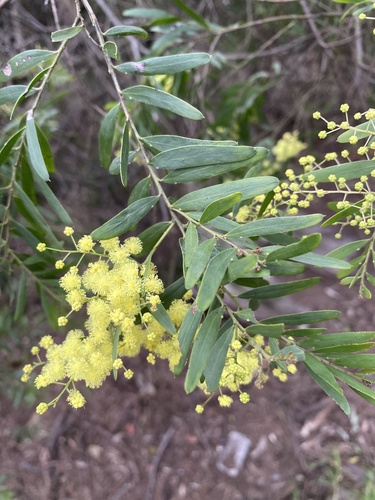
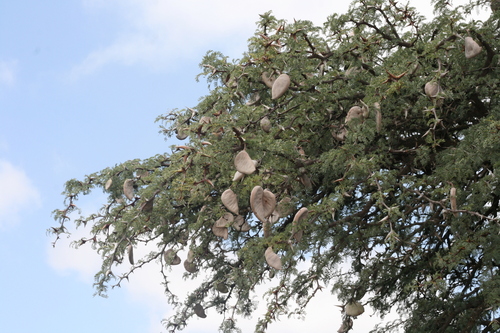
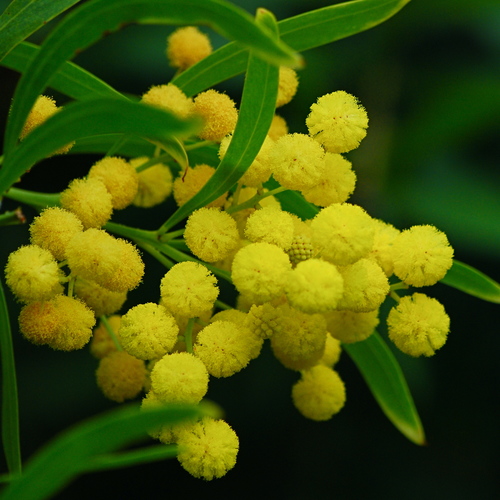
Acacia retinodes Schltdl. is a tree that typically grows to a height of 6 to 10 metres (20 to 33 feet) and can form suckers. Its bark is furrowed, rough in texture, and coloured dark brown to black. It has glabrous branchlets that are sometimes pendulous, or angular or flattened at the tips. Like most Acacia species, it has phyllodes instead of true leaves. These phyllodes are green to grey-green, glabrous, and variable in form; they are quite crowded on stems, and shaped from narrowly oblanceolate to linear. The phyllodes measure 5 to 16 cm (2.0 to 6.3 in) in length and 3 to 16 mm (0.12 to 0.63 in) across, with one main nerve per face. It mostly blooms in summer, between December and February.
In South Australia, this species is native to the Mount Lofty Ranges, ranging from around Mount Clare to Mount Bryan, and extending down the Fleurieu Peninsula to around Delamere and Normanville in the south. It is considered a weed further to the southeast in the state. It commonly grows on low ranges and hills as a component of Eucalyptus woodland communities.
Acacia retinodes has several uses. It is used for environmental management and as an ornamental plant. It produces good quantities of gum, and its bark is suitable for tanning. It has been awarded the Royal Horticultural Society's Award of Garden Merit. In temperate regions, it needs a frost-free, sheltered location with full sun. Indigenous Australians softened the gum in water and ate it to relieve chest pains. In temperate climates, it is grown as a houseplant; it is resistant to most diseases and pests. It can be grown in almost any well-drained potting soil, but needs ample light and water from spring to summer. Watering should be reduced in autumn and winter. Repotting is generally required at the start of each growth season. The plant is usually propagated from seed, but can also be propagated from cuttings, though cuttings may take several months to develop roots.