About Acacia pulchella R.Br.
Scientific name: Acacia pulchella R.Br.
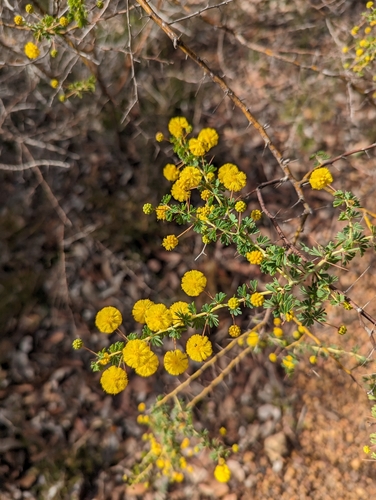
Description This prickly shrub commonly known as prickly moses (a name thought to be a corruption of "prickly mimosa") typically grows to a height of 1.5 m (4 ft 11 in). It branches freely, and has flexuose, spine-tipped pale green branchlets with 1 mm (0.039 in) stipules. Unlike most Acacia species, it has true bipinnate leaves rather than phyllodes, with each leaf made up of three to five pinnae. The leaves are feathery, with individual leaflets reaching up to 5 mm long, and one or two spines grow at the base of each leaf. It flowers in late winter and early spring. Its rudimentary inflorescences form groups of one to three racemose spherical flower heads, each around 1 cm (0.39 in) in diameter, that usually contain 10 to 40 golden flowers, sometimes up to 60. After flowering, it produces crustaceous seed pods that are narrowly oblong in shape, flat or slightly undulate, measuring 1.5 to 5 cm (0.59 to 1.97 in) long and 3 to 5 mm (0.12 to 0.20 in) wide. The brown seeds inside the pods are mostly oblong and 2.5 to 4.5 mm (0.098 to 0.177 in) long.
Distribution It is native to Western Australia, where it is found in the Perth, Peel, South West, Great Southern regions, and southern parts of the Wheatbelt and Mid West. It commonly grows in swamps, low-lying areas, and near creeks and rivers. Its natural range extends from near Geraldton in the north down to near Esperance in the east, and to coastal areas in the west and south. One isolated population has also been recorded in Creek Conservation Park, South Australia.
Ecology Recent research indicates that under some circumstances, A. pulchella may suppress the plant pathogen Phytophthora cinnamomi.
Uses This prickly shrub is useful as a barrier to restrict animal and human access to areas.