About Acacia provincialis A.Camus
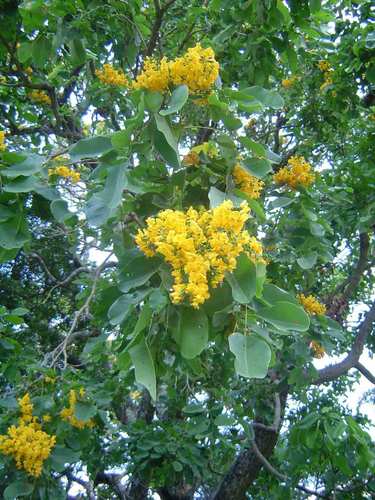
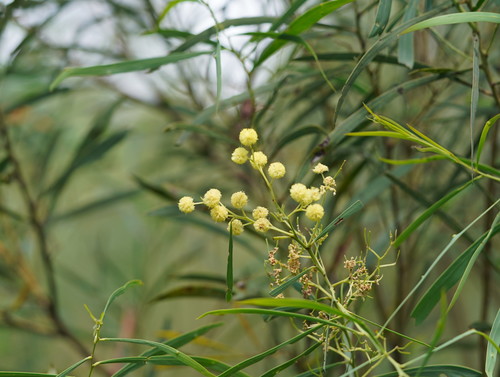
**Description**: This tree has a slender, erect growth habit, and typically reaches a height of up to 10 metres (32.8 ft). It has a bushy crown, and usually grows with a single stem, though it may also divide into several stems at ground level; the stems bear smooth grey bark. Branchlets are usually pendulous, angled or flattened, reddish-brown, and often covered with a white powdery coating. It has glabrous, blue-green to grey-green phyllodes that are straight or shallowly recurved, shaped as narrowly oblanceolate, narrowly elliptic, or linear; phyllodes measure 7 to 22 cm (2.8 to 8.7 in) in length and 3 to 15 mm (0.12 to 0.59 in) in width. It can bloom year-round, with peak flowering occurring between September and January. It produces racemose inflorescences, holding spherical flower-heads that contain 18 to 50 golden to pale yellow flowers. After flowering, linear brown seed pods form, reaching up to 16 cm (6.3 in) in length and 5 to 17 mm (0.20 to 0.67 in) in width, with a firm papery texture. The dull to slightly shiny dark brown to black seeds inside the pods are oblong to oblong-elliptic in shape, and measure 4 to 6 mm (0.16 to 0.24 in) in length.
**Distribution**: This species is endemic to Kangaroo Island, Fleurieu Peninsula, and the Mount Lofty Ranges in South Australia. It also occurs across much of central and eastern Victoria, where it grows in damp areas on and along the margins of swamps and creeks, in sandy, clay, or loamy soils. In Victoria, most of the population occurs between the Glenelg River in the Grampian Ranges and the area near Melbourne, where it is often a component of open-forest communities growing in poorly drained soils located well inland from the coast. Specimens have also been collected in Tasmania, from King Island and the area near Launceston.