About Acacia pravissima F.Muell.
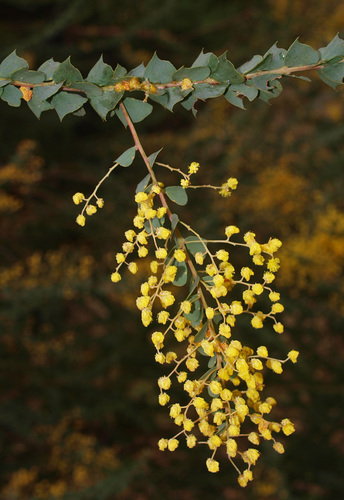
Acacia pravissima F.Muell., commonly called Ovens wattle, typically grows as a shrub or small tree reaching 0.5 to 3 metres (1+1⁄2 to 10 ft) in height, though it can grow as tall as 8 m (26 ft). It has slender to spreading branches, with ribbed branchlets that are either hairless or hairy. Like most Acacia species, it has phyllodes instead of true leaves. The grey-green phyllodes are crowded onto short stem projections; they are hairless, distinctly inequilateral, and obdeltate in shape, measuring 7 to 16 millimetres (1⁄4 to 5⁄8 in) long and 5 to 14 mm (3⁄16 to 9⁄16 in) wide. This species produces ball-shaped yellow flowers arranged in racemes, blooming during winter and spring. The abundant inflorescences hold spherical flower heads 5 to 6 mm in diameter, each containing 8 to 12 golden flowers. After flowering, it forms firmly chartaceous, hairless seed pods that are narrowly oblong in shape, growing up to 8 centimetres (3 in) long and 6 to 9 mm (1⁄4 to 3⁄8 in) wide. Inside the pods, the dull black seeds are oblong to ovate, 3 to 5 mm (1⁄8 to 3⁄16 in) long, with a clavate aril. This species is endemic to southeastern Australia, where it occurs in higher elevated areas of the Great Dividing Range. Its range extends from around Tumut, located in the South West Slopes and Southern Tablelands of New South Wales in the north, south through the Cotter Range and the Australian Capital Territory, to the area around the Strathbogie Range and Macalister River in Victoria. It most often grows in damp, sheltered sites along creeks and streams, and is typically a component of Eucalyptus forest and woodland communities. In cultivation, Ovens wattle is hardy and easy to grow. It can be propagated from scarified seed, grows in most soil types in full sun or part shade, and prefers well-drained soil. It is frost hardy down to −7 °C (19 °F).