About Acacia podalyriifolia A.Cunn. ex G.Don
Scientific name: Acacia podalyriifolia A.Cunn. ex G.Don
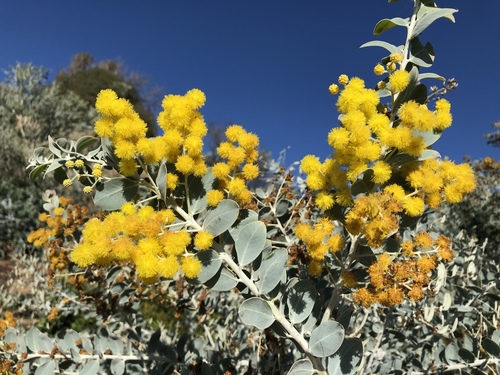
Description: Acacia podalyriifolia is a tall shrub or small tree that usually grows 2 to 6 m (6 ft 7 in to 19 ft 8 in) tall and wide. Like most Acacia species, it has phyllodes instead of true leaves. Its bark is grey, with a smooth or finely fissured texture; its branchlets are cylindrical (terete), hairy, and often covered in a fine white powdery coating. The silver-grey to grey-green phyllodes are broadly elliptic to ovate in shape, 2 to 5 cm (0.8 to 2.0 in) long, 10 to 25 mm (0.4 to 1.0 in) wide. They have hairy margins and a prominent midvein.
A. podalyriifolia flowers year-round, producing simple inflorescences arranged in groups of 8 to 22 along an axillary raceme with an axis 2 to 11 cm (0.8 to 4.3 in) long. The spherical flower heads are 5 to 8 mm (0.2 to 0.3 in) in diameter, and hold 15 to 30 bright golden flowers.
Distribution: This species is endemic to southeastern Queensland and northeastern New South Wales, Australia, occurring in areas north of Legume. It has become naturalised further south in open woodland or forest communities, and also naturalised in Western Australia and South Australia. Outside Australia, it is naturalised in southern and eastern Africa, parts of the Indian Subcontinent and Southeast Asia, some Indian Ocean islands, New Zealand, Brazil, Argentina, and southwestern United States of America. It grows well in subtropical and tropical conditions, and can tolerate semiarid climates.