About Acacia parramattensis Tindale
Scientific name: Acacia parramattensis Tindale
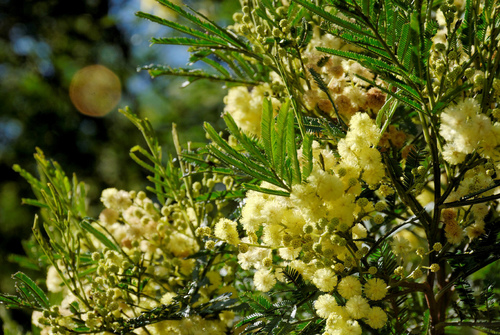
Description Acacia parramattensis is an upright tall shrub or tree that reaches 2 to 15 m (7 to 50 ft) in height. It has smooth bark that may be dark green, dark brown, or black. Its branchlets are more or less round in cross-section (terete), and sometimes have ridges. Tips of new growth are yellow, finely furry, and become smooth as they mature. Dark green, slightly rough leaves connect to the stem via a 0.5–2 cm (1⁄4–3⁄4 in) long petiole, and are finely divided (bipinnate): each leaf produces 3–16 pairs of 1.5–6 cm (1⁄2–2+1⁄4 in) long pinnae (leaf stalks), and each pinna bears 14 to 62 (most commonly 20 to 40) pairs of pinnules. Individual pinnules are 2 to 7 (rarely 9) mm long, 0.5–1 mm wide, and linear or cultrate in shape.
Yellow spherical flowers 4–7.5 mm (0.16–0.30 in) in diameter appear from November to February, and occasionally as late as April. Flowers are arranged in panicles or racemes, with 25 to 50 flowers per flower head. After flowering, flat grey-black seed pods develop: rough and furry when young, they lose their fur as they mature, reaching 2.5–11 cm (1–4+1⁄4 in) long and 3.5–8 mm (1⁄8–3⁄8 in) wide. The pods are sub-moniliform: linear in shape, with slight bulges over the positions of the seeds. Mature seeds are released between November and January. A. parramattensis typically flowers later in the year than the related species early green wattle (Acacia decurrens) and black wattle (A. mearnsii).
Distribution and habitat Acacia parramattensis is native to the Sydney Basin and Blue Mountains in central New South Wales, ranging north to Yengo National Park, west to Grenfell, and south to Tumut, occurring from sea level up to 900 metres (3,000 ft) elevation. It is a component of dry sclerophyll forest or woodland, growing alongside tree species including forest red gum (Eucalyptus tereticornis), Sydney blue gum (E. saligna), mountain white gum (E. dalrympleana), rough-barked apple (Angophora floribunda), and turpentine (Syncarpia glomulifera). In drier locations it grows with gossamer wattle (Acacia floribunda), coast myall (A. binervia), or early green wattle (A. decurrens). It is also part of the rare, fragmented Southern Highlands Shale Woodlands community.
Acacia parramattensis grows on alluvial or shale-based low- to medium-nutrient soils, often with some clay content, and occasionally occurs on sandstone-based soils. It can be found on lower slopes, along watercourses, and on ridges, in areas with annual rainfall over 700 millimetres (28 in). It may have naturalised in Tasmania and other parts of New South Wales outside its native range.
Ecology The thin bark of A. parramattensis provides little protection from bushfire, and plants generally die in high intensity fires. Most above-ground growth is killed by fire, though plants with trunks thicker than 10–15 cm (4–6 in) diameter at breast height (dbh) may resprout from epicormic buds, and some plants can survive low intensity fires. This species has a suckering growth habit and can regrow from basal shoots after fire, but regeneration after severe fires is usually via seed. Seeds have a hard coating and persist in soil after being released from seed pods. A. parramattensis colonises disturbed areas, and suckers can form dense groves of plants. The species has a juvenile growth period of around five years.
Seeds of A. parramattensis are eaten by the common bronzewing pigeon (Phaps chalcoptera). Foliage is a food source for caterpillars of moonlight jewel (Hypochrysops delicia), imperial hairstreak (Jalmenus evagoras), and amethyst hairstreak (Jalmenus icilius); adult imperial hairstreaks also visit the plant. Wood is consumed by larvae of the jewel beetle species Melobasis nitidiventris, Agrilus hypoleucus, and Agrilus australasiae. Older trees infested by borers in turn attract the insectivorous yellow-tailed black cockatoo. A. parramattensis is a host species for the mistletoes Amyema cambagei and Amyema pendula.
Cultivation Acacia parramattensis is not commonly cultivated, though it is grown locally in Sydney and the Blue Mountains. It is fast growing and adaptable, reaching 6 to 8 m (20 to 26 ft) high over five years. It can provide shade in gardens, but is vulnerable to borer infestation. It is propagated from seed. Fieldwork in the Southern Highlands found that the presence of bipinnate wattles (as either understory or trees) correlates with fewer noisy miners, an aggressive bird species that displaces smaller native birds from gardens and bushland. The study therefore recommended using bipinnate wattles including A. parramattensis in establishing green corridors and for revegetation projects.