About Acacia oswaldii F.Muell.
Scientific name: Acacia oswaldii F.Muell.
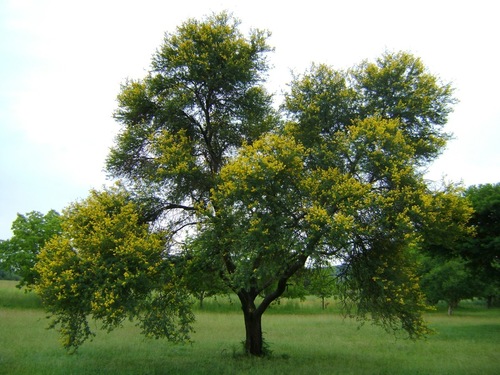
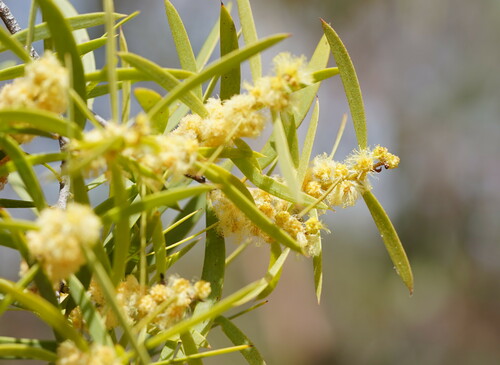
Description: This species typically grows as a shrub or tree reaching 1 to 6 metres (3 to 20 ft) in height, and may grow up to 8 m (26 ft) tall. It has terete, glabrous branchlets covered in many red, resinous micro-hairs. Its phyllodes are spreading to erect, with foliage that is linear, narrowly elliptic, or narrowly oblong-elliptic in shape; foliage is straight to recurved, and ranges from terete to flat, measuring 2.5 to 10.5 centimetres (1 to 4 in) long and 3 to 15 millimetres (0.12 to 0.59 in) wide. Young leaves are hairy, becoming hairless with age; they have smooth edges and terminate in a straight, often sharp point. It blooms from October to December, producing yellow flowers. Simple inflorescences grow singly or in pairs in the axils of phyllodes, and are supported on hairy peduncles 0 to 1 millimetre (0.00 to 0.04 in) long. Flowers form globose heads 5 to 8 mm (0.2 to 0.3 in) in diameter, holding 5 to 16 individual flowers. After flowering, it produces curved or coiled seed pods that are mostly flat, except where they bulge over the seeds. The pods are leathery to woody, measuring 4 to 25 cm (1.6 to 9.8 in) long and 5 to 12 mm (0.2 to 0.5 in) wide. Seeds can be collected from March to May and sown from November to February; they germinate in 3 to 10 weeks. A. oswaldii can also be propagated from cuttings.
Distribution: It is native to central and southern South Australia, the central and southern Northern Territory, south-west Queensland, western New South Wales, northern Victoria, and the Pilbara and Goldfields-Esperance regions of Western Australia. It has a wide but scattered distribution across arid, semi-arid and subtropical areas of all mainland Australian states, and occurs mainly in calcareous sands or loamy soils.