About Acacia obliquinervia Tindale
Scientific name: Acacia obliquinervia Tindale
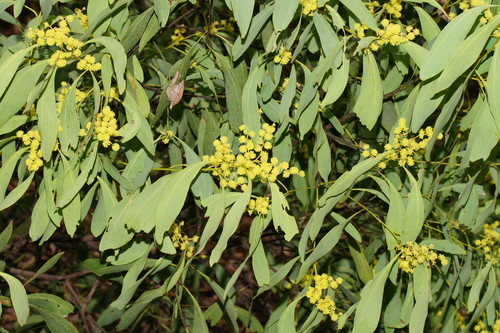
Description: This species grows as a shrub or tree reaching 1 to 15 metres (3 ft 3 in to 49 ft 3 in) in height, with an erect or spreading growth habit. It has dark brown, deeply fissured bark, and angled or flattened glabrous branchlets that are often covered in a fine white powdery coating. Like most Acacia species, it has phyllodes rather than true leaves. These evergreen, glabrous phyllodes are shaped obovate to narrowly oblanceolate, occasionally narrowly elliptic, measuring 5 to 17 cm (2.0 to 6.7 in) long and 9 to 55 mm (0.35 to 2.17 in) wide, with a prominent midvein.
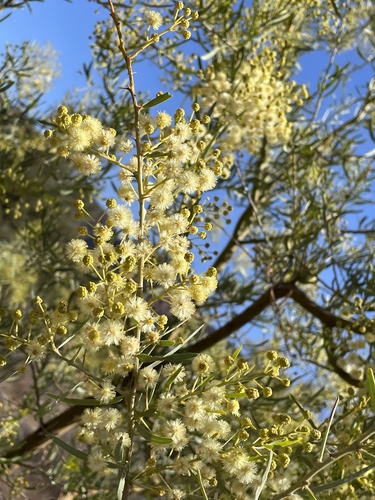
It blooms between August and December, producing simple inflorescences arranged in clusters of 3 to 16 in racemes along a zig-zagged axis 1 to 10 cm (0.39 to 3.94 in) long. The inflorescences bear spherical flower-heads 5 to 8 mm (0.20 to 0.31 in) in diameter, containing 20 to 35 bright yellow flowers.
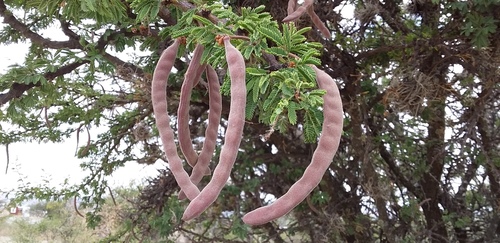
After flowering, it forms chartaceous to thinly coriaceous oblong seed pods that are 4 to 15 cm (1.6 to 5.9 in) long and 12 to 25 mm (0.47 to 0.98 in) wide, and the pods may be covered in a fine white powdery coating. The dull to slightly shiny black seeds inside the pods are shaped oblong-elliptic to ovate, and measure 5 to 6 mm (0.20 to 0.24 in) long.
Distribution: The species is native to south eastern New South Wales, the Australian Capital Territory, and Victoria in eastern Australia. In New South Wales, it occurs in tableland areas of the Great Dividing Range south of the Goulburn River valley, where it grows in soils derived from surrounding sandstone as part of moist or dry sclerophyll forest and woodland communities. In Victoria, it occurs in central and eastern parts of the state, with a range extending from the Grampians to areas east of Melbourne. It is commonly found in montane woodlands and forests at altitudes between 500 and 1,700 m (1,600 to 5,600 ft).