About Acacia nyssophylla F.Muell.
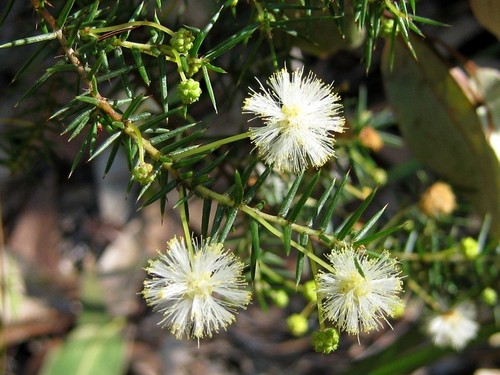
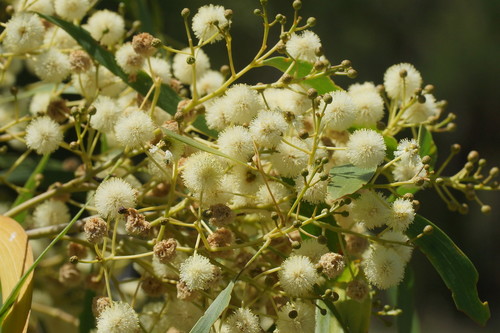
Acacia nyssophylla F.Muell. is an intricate, prickly shrub that typically grows to between 0.5 and 3 metres (2 to 10 ft) in height. It has hairless branchlets that leave scars where phyllodes have detached. Like most Acacia species, it has phyllodes instead of true leaves. These evergreen phyllodes attach to yellow stem projections. They are pungent, rigid, dull, and glabrous, ranging from straight to shallowly curved. They measure 15 to 35 mm (0.59 to 1.38 in) long, around 1.5 mm (0.059 in) wide, and have around 20 obscure veins. It blooms from July to October, and sometimes as late as November. It produces simple inflorescences that usually grow in pairs in the axils, with spherical to ellipsoidal flower-heads 3.5 to 6 mm (0.14 to 0.24 in) in diameter, containing 12 to 19 golden flowers. After flowering, it forms firmly chartaceous, linear seed pods that are slightly constricted between individual seeds, and range from curved to once-coiled. The glabrous pods are 3 to 6.5 cm (1.2 to 2.6 in) long, 2 to 5 mm (0.079 to 0.197 in) wide, and have longitudinal veins. Inside the pods are glossy black seeds with a lanceolate-oblong or oblong-elliptic shape, 4 to 5 mm (0.16 to 0.20 in) long, with a large orange or yellow aril. This species is native to the Wheatbelt and Goldfields-Esperance regions of Western Australia. Its native range extends through South Australia to extreme north-western Victoria; north from South Australia to near Alice Springs in the Northern Territory; and to western New South Wales near Bourke.