About Acacia mearnsii De Wild.
Scientific name: Acacia mearnsii De Wild.
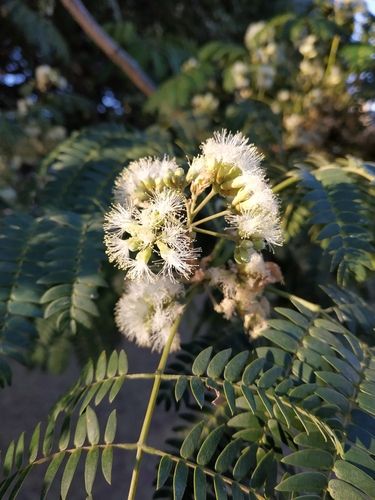
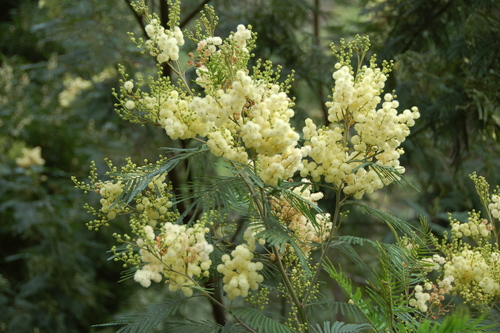
Description: Acacia mearnsii is a spreading shrub or erect tree that typically reaches 10 m (33 ft) in height. It has smooth bark, which is sometimes corrugated at the base of older specimens. Its leaves are bipinnate, with 7 to 31 pairs of pinnae, each bearing 25 to 78 pairs of pinnules. A spherical gland grows up to 8 mm (0.31 in) below the lowest pair of pinnae. Scented pale yellow or cream-colored flowers are arranged in spherical heads of 20 to 40 flowers, held on hairy peduncles 2–8 mm (0.08–0.31 in) long. Flowering mainly occurs from October to December, and black to reddish-brown seed pods 30–150 mm (1.2–5.9 in) long and 4.5–8 mm (0.18–0.31 in) wide develop between October and February.
Distribution and habitat: A. mearnsii is native to southeastern Australia and Tasmania. It has been introduced to North America, South America, Asia, Europe, Pacific and Indian Ocean islands, Africa, and New Zealand. In introduced areas, it is often grown commercially for tannin production, or used as a local source of firewood. In some regions, introduced A. mearnsii is classified as a weed: it threatens native habitats by competing with indigenous vegetation, replacing grass communities, reducing native biodiversity and increasing water loss from riparian zones. In Africa, it competes with local vegetation for scarce nitrogen and water resources, endangering the livelihoods of millions of people. In its native range, A. mearnsii grows in tall woodland and forest habitats of subtropical and warm temperate regions. In Africa, it grows in disturbed areas, range/grasslands, riparian zones, urban areas, water courses, and mesic habitats at altitudes between 600 and 1,700 metres (2,000 and 5,600 ft), in a range of climates including warm temperate dry climates and moist tropical climates. A. mearnsii tolerates annual precipitation between 66 and 228 cm (26 and 90 in), annual mean temperatures from 14.7 to 27.8 °C (58.5 to 82.0 °F), and soil pH of 5.0–7.2. It does not grow well on very dry, poor soils.
Ecology in Australia: A. mearnsii plays an important role in Australia's native ecosystems. As a pioneer plant, it quickly stabilizes erosion-prone soil after bushfires, which are common in its native habitat. Like other leguminous plants, it fixes atmospheric nitrogen in soil via bacterial nodules in its extensive root system, and this increased nitrogen can be rapidly used by other woodland species, making it critical for the natural regeneration of Australian bushland after fires.
Seed dispersal routes for A. mearnsii include: transport by rodents, birds, or cattle; accidental spread by local people collecting firewood; spread via movement of seed-contaminated soil; and downstream dispersal along water courses by its hard-coated seeds. Mycorrhizal fungi grow on A. mearnsii roots and produce food that feeds marsupials, which then disperse the fungi's spores in their droppings to maintain the symbiotic relationship between the tree roots and the fungi. Cracks and crevices in the bark of A. mearnsii provide habitat for many insects and invertebrates. The rare Tasmanian hairstreak butterfly lays its eggs in these bark cracks; hatching caterpillar larvae are attended by ants (Iridomyrmex sp.) that feed on sweet exudates produced by the larvae. A. mearnsii also acts as a larval host plant and food source for the imperial hairstreak (Jalmenus evagoras). The tree hosts various grubs, including wood moth larvae, which are a food source for black cockatoos that strip bark to access these borers. During winter, A. mearnsii supports insects, birds, and marsupials via nectar supplies in its leaf axils. these visiting animals perform an important predatory role that controls tree dieback caused by scarab beetles and pasture pests. A. mearnsii, along with gums, native box and native hop, forms the framework vegetation for so-called "hill-topping" sites: these are typically isolated remnant pockets of native vegetation surrounded by exotic pasture. Hill-topping sites are critical mating habitat for male butterflies that attract females here before females lay eggs in close proximity, and these are the only acceptable mating sites for these butterflies in the region. Black wattle flowers produce nitrogen-rich pollen and no nectar, attracting pollen-feeding birds including wattlebirds, yellow-throated honeyeaters and New Holland honeyeaters. Protein-rich nectar in the leaf axils supports the growth of juvenile nestlings and young invertebrates such as ants. Ants harvest A. mearnsii seeds, drawn by the fleshy, oil-rich elaiosome (seed stalk); they bury and store seeds in widely dispersed locations, where buried seeds remain ready to germinate with the next soaking rains. However, a wattle seed-eating insect uses a proboscis-like injector to pierce the seed testa and suck out the embryo, which often reduces seed viability. A. mearnsii is also grown locally as an ornamental plant.
Reproduction: A. mearnsii produces copious numbers of small seeds that are not dispersed actively. It can resprout from basal shoots after fire, and produces numerous suckers that form thickets of clones. Seeds can remain viable for up to 50 years.
Uses: The Ngunnawal people of the Australian Capital Territory use the tree's gum as food, and mix it with ash to make cement. To ensure a steady sap supply, they cut the tree's bark in autumn. Bark is also used to make coarse rope and string, and infusions of bark in water are used as a traditional medicine for indigestion.